

Joseph Conroy · Owner, Launch Happy
Building AI That Had to Be Right - Since 1997.
Owner, Launch Happy · Founder & CEO, VectorCertain · Author of three AI books
Before AI wrote poems, Joseph Conroy's AI controlled industrial hardware, predicted emissions the EPA came to validate, and traded electricity futures on NYMEX. Today he occupies an unusual intersection: he owns a small-business marketing agency - and runs an AI safety company. One side helps Squarespace businesses get found and cited; the other works on how AI systems can be trusted at all. The GEO Certified™ standard exists because those turned out to be the same problem.
Who is Joseph Conroy, and what is his role at LaunchHappy?
Joseph Conroy is the owner of LaunchHappy, a Squarespace-focused GEO-SEO agency, and the Founder & CEO of VectorCertain, an AI Safety and Governance company. He has built and commercialized AI systems since 1997 - from EPA-validated industrial monitoring to AI-driven energy trading on NYMEX. He created and maintains LaunchHappy's GEO Certified™ standard, has filed 21 patents in AI safety and governance, had seven- and eight-figure exits, and is the author of three AI books: The AI Agent Crisis and the two-volume MYTHOS Playbook.
Joseph has been building commercial AI since 1997, when his company Envatec developed the ENVAIR2000 - the first commercial application in the United States to use AI for parts-per-trillion industrial gas detection, with the AI directly controlling the hardware itself. Its successor, the ENVAIR4000, earned a $425,000 NICE3 federal grant for predicting industrial failures before they happened.
Then came the part that shaped everything since: the EPA selected Joseph as a technical resource for its program validating AI-predicted emissions, choosing his International Paper mill test site for the agency's own evaluation - work that contributed to AI-based predictive emissions monitoring becoming codified in federal regulations. His AI didn't just pass a standard. It helped become one.
He then founded EnvaPower, the first U.S. company to use AI to predict electricity futures on NYMEX - and exited at eight figures. Across 25+ years of mission-critical AI work in federally regulated environments, one rule never changed: "the AI was probably right" has never been an acceptable answer.
On the marketing side, Joseph owns LaunchHappy (100%), which has served 600+ Squarespace businesses across 30+ countries since 2020, optimized more than 50,000 pages, and maintained a 4.9/5 rating doing it - the honest, email-only, no-phone-calls way.
On the safety side, Joseph is the Founder & CEO of VectorCertain, whose SecureAgent platform governs autonomous AI agent actions before they execute. Under his leadership, VectorCertain became the first and only Safety/AI (S/AI) participant in the history of MITRE ATT&CK® Evaluations (ER8). He has filed 21 patents with the USPTO in AI safety and governance, with more than 30 additional filings in process, and VectorCertain has been accepted into Anthropic's Claude Partner Network, where it is completing the partner certification pathway.
The signature of his safety work is publication: defined test corpora, scoring engines, human sign-off, and results released with the statistics attached - the same discipline his books teach.
When search shifted from Google's ten blue links to AI-generated answers, most marketers saw a new channel. Joseph saw a familiar problem: AI engines deciding what to trust.
Getting a business cited by ChatGPT, Perplexity, or Google's AI is - mechanically - a question of how AI systems select, verify, and reproduce information. Which sources they weigh. What corroboration they require. What structure they can extract. How they handle inconsistency. That's not marketing intuition territory; it's the discipline Joseph's safety work lives in every day.
And here's why LaunchHappy now sells SEO and GEO as one package: the signals substantially overlap. The structure that earns a Google ranking and the structure that earns an AI citation are built from the same materials - clean entities, real sources, extractable answers, verifiable authority. Splitting them into separate services would mean charging twice for one discipline. So every package optimizes for both surfaces at once: found by search engines, cited by answer engines, measured against one published standard.
The GEO Certified™ standard is that discipline in public: a published 10-criterion specification, built on peer-reviewed research (Princeton, Carnegie Mellon), scored by an analysis engine rather than eyeballed, with mandatory human review on everything. It's tested the way safety systems are tested - with a defined standard, a scoring engine, and a human sign-off.
"Most agencies are guessing at how AI engines choose what to cite. We built our standard on the published research - and we test against it the same way we test safety systems: with a defined corpus, a scoring engine, and a human sign-off."
- Every certified deliverable is verifiable - against a public standard, with a score, not a vibe
- Human review is non-negotiable - no unedited AI output ships under a client's name, ever
- Claims stay honest - no citation guarantees, no ranking promises; measured results instead
- One package, both surfaces - SEO and GEO delivered together, because the signals are the same family
- The standard evolves with the engines - maintained by someone whose day job is watching how AI systems actually behave

The AI Agent Crisis
The AI Agent Crisis: How To Avoid The Current 70% Failure Rate & Achieve 90% Success
The accessible one — why most autonomous AI agent deployments fail, and what disciplined engineering does differently. Written for leaders deploying AI, not just the engineers building it.
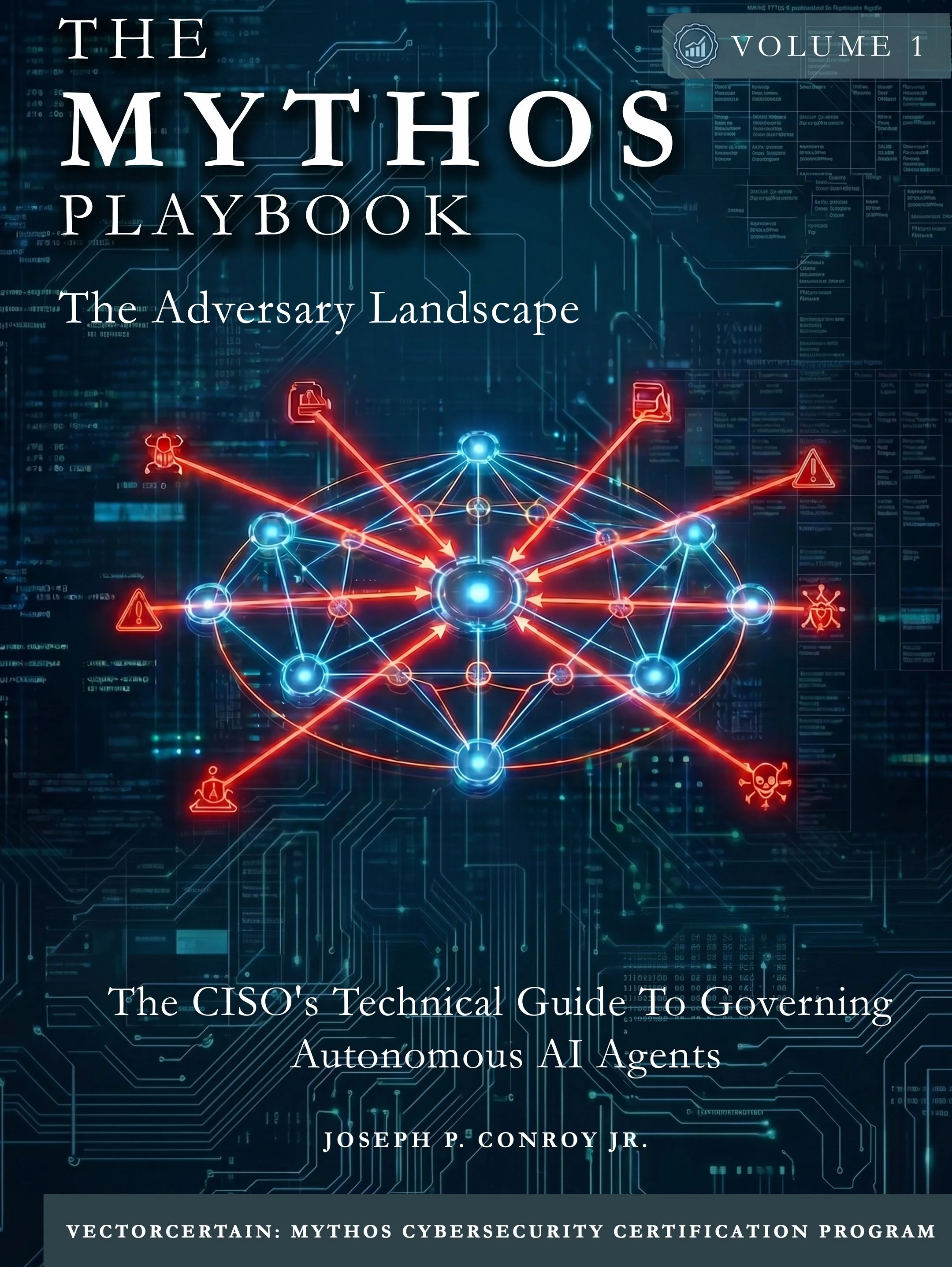
The MYTHOS Playbook, Volume I
The MYTHOS Playbook, Volume I: The Adversary Landscape
Volume I of the two-volume CISO desk reference, built from a 7,000-scenario internal AI-safety test corpus: the autonomous-agent threat landscape and the statistical certification methodology for proving a defense actually works — chapters include "What ≥99.0% Recall at 3-Sigma Actually Means" and "Vendor Evaluation: A Statistical Field Test."
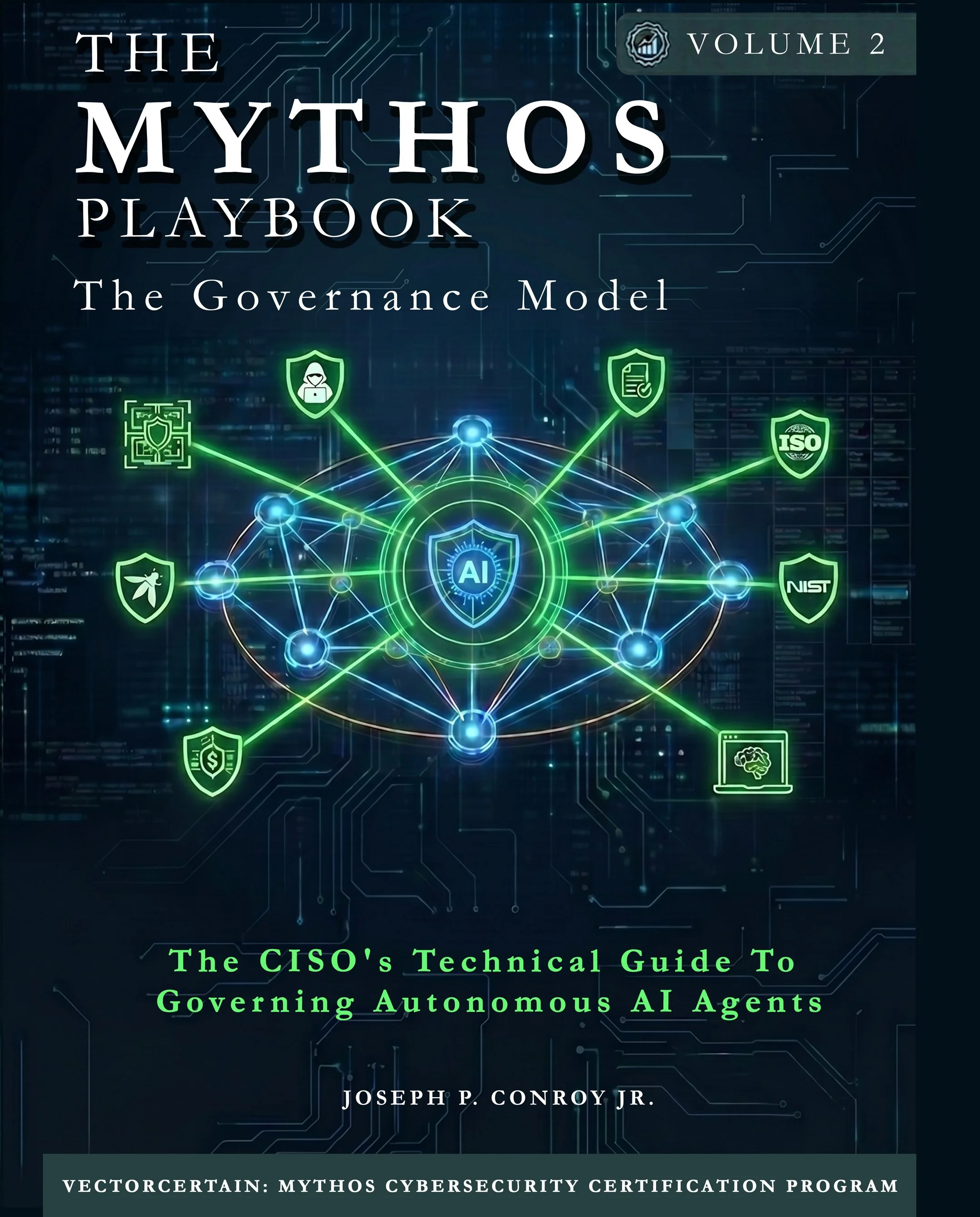
The MYTHOS Playbook, Volume II
The MYTHOS Playbook, Volume II: The Governance Model
Volume II: the governance architecture — how pre-execution AI governance gets wired into real organizations. Together the two volumes span 34 chapters and a 297-entry bibliography, with control cross-walks to MITRE ATT&CK®, NIST AI RMF, ISO/IEC 42001, OWASP, and the EU AI Act.
The Standard Is Public.
Check Our Work Against It
Free · 48-hour delivery · Works on any website