If you run a small business, you have probably heard some version of "SEO is dead" or "everyone is switching to ChatGPT." Both claims are too simple. What is actually happening is more useful to understand, because it tells you where to spend your time.
People now have two common ways to look for a business or service. They can search Google and compare results themselves, or they can ask an AI tool and get a summary. Many people do both, sometimes in the same afternoon. Google has also started showing AI-written summaries at the top of many searches, so the line between "Google search" and "AI search" is getting blurry.
This post explains how the two work, where they differ, what stays the same, and what to adjust on your own website. It is written for business owners, not engineers, so there is no jargon you need to memorize. If you want the broader definition of the practice behind all this, start with What Is GEO (Generative Engine Optimization) and Why Your Business Needs It.
What is the main difference between AI search and Google search?
The main difference is the format of the result. Google gives you options. AI tools give you an answer.
When you search Google for "best Squarespace designer for photographers," you get a page of links, ads, maps, and maybe a summary. You decide which ones to open, compare them, and form your own opinion.
When you ask an AI tool the same question, it reads a set of sources, combines what it finds, and writes a response. It might name two or three designers, explain why, and list the sources it used. You may never visit a single website to get what you needed.
Same question, two different results:
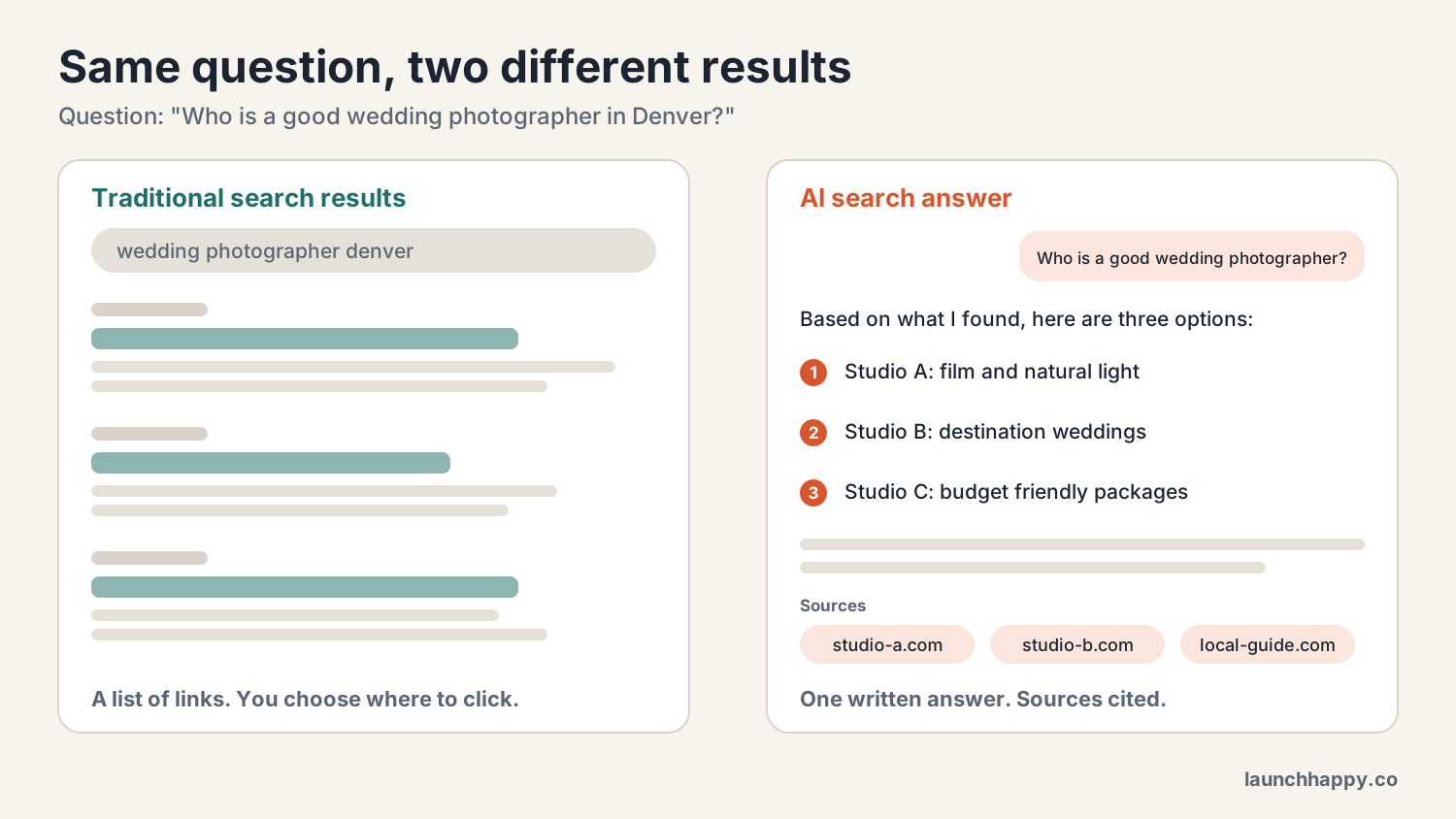
That difference changes what winning looks like. In a list of links, being number three still gets you clicks. In a written answer, there may only be room for a handful of names.
How does Google search work?
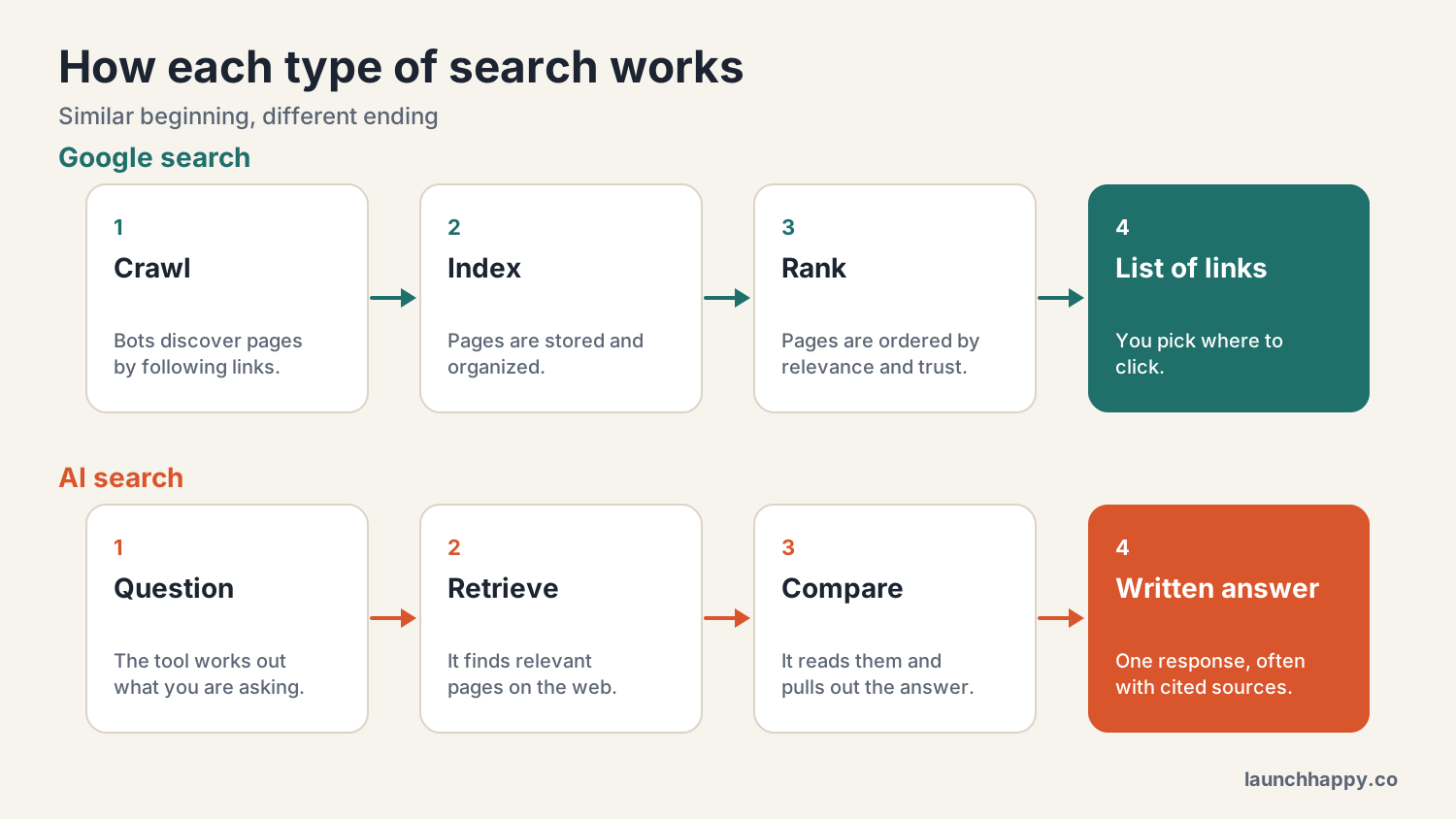
Google's process has three main stages, and it has stayed fairly consistent for years.
Crawling. Google sends automated programs, often called crawlers or bots, across the web to discover pages by following links and reading sitemaps.
Indexing. Google stores and organizes what it finds so it can retrieve pages quickly. It tries to understand what each page is about.
Ranking. When someone searches, Google decides which pages best match the question and orders them. Hundreds of signals feed into that decision, including how relevant and helpful the content is, how trustworthy the site seems, how other sites link to it, and how well the page works on mobile.
The output is a ranked list. Your job in traditional SEO is to earn a high position in that list and a click.
How does AI search work?
AI search tools do something different at the end of the process, even though the beginning looks similar.
Most of them combine two things: a large language model that is very good at writing and summarizing, and a way of looking up information from the web or other sources. Here is a simplified version of what happens when you ask a question:
The tool interprets your question. It figures out what you are really asking, including the context from earlier in the conversation.
It retrieves sources. It searches for relevant pages, often using traditional web search results as one input.
It reads and compares. It pulls out the parts of those sources that answer your question.
It writes an answer. The model composes a response in its own words, and many tools show which sources they relied on.
The details vary by product, and the companies change them often. Some tools lean heavily on live web results. Others rely more on what the model already learned during training and only sometimes look things up. That is one reason the same question can give different results in different tools, or even in the same tool on different days.
How Google and AI search each work:
What stays the same?
It is easy to read headlines and assume everything has to be rebuilt. It does not. Several fundamentals carry over directly.
What stays the same and what changes:
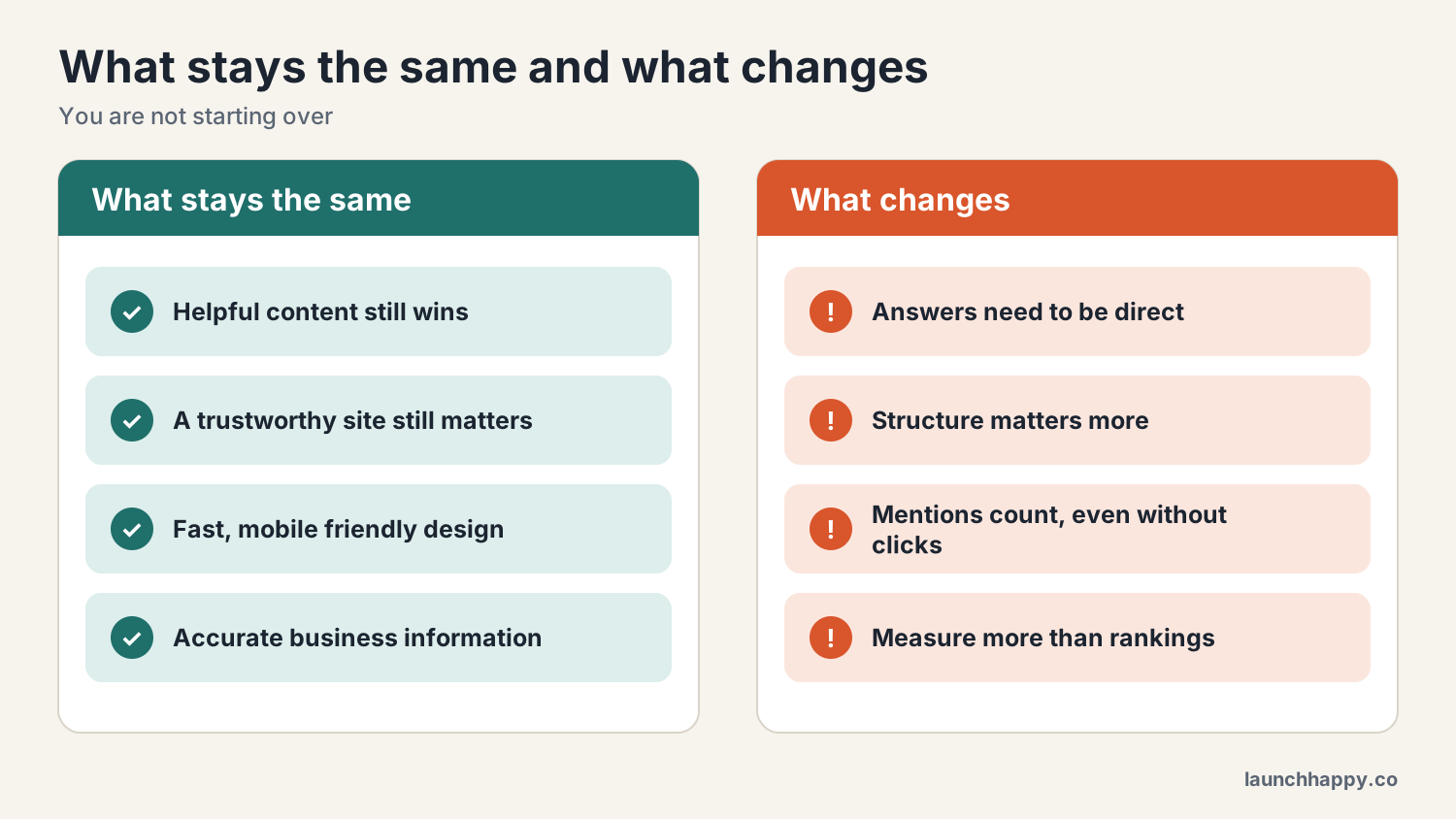
Helpful content still wins. Whether a person or an AI tool is reading, pages that explain things clearly and specifically do better than pages stuffed with filler.
Trust still matters. Real reviews, a clear About page, accurate contact information, and mentions on reputable sites help in both worlds.
Technical health still matters. A site that loads slowly, breaks on phones, or cannot be crawled is a problem for Google and for AI tools.
Your foundation counts. Because many AI tools lean on web search results to find sources, a site that already ranks reasonably well often has a head start.
If you have invested in your SEO, that investment still pays off. It is just no longer the whole picture.
What changes for your business?
A few things shift, and they are worth taking seriously.
Your answers need to be direct. AI tools favor pages that answer a question plainly. If your page makes the reader hunt for the answer, an AI tool is less likely to use it. Put the clear answer near the top of the page, then add the detail.
Structure matters more. Clear headings, short paragraphs, lists, FAQ sections, and schema markup (code that tells machines what your content means) make it easier for AI tools to pull out the right piece of your page.
Mentions count, even without clicks. In Google, the click is the prize. With AI tools, your business being named in an answer has value even if the person does not click right then. They may search your name later, visit directly, or call. That makes your brand name and the consistency of your business details more important than ever.
You need to measure differently. Rankings alone will not tell you how you are showing up in AI answers. You will want to track a few other things, which we cover below.
Conversations replace keywords. People ask AI tools long, specific questions like "I run a small bakery in Austin and need a website that takes preorders, who should I talk to?" Content that speaks to specific situations like that tends to match these questions better than generic pages.
Is AI search replacing Google?
Right now, the honest answer is: not entirely, and not evenly.
Google is still where most people begin many kinds of searches, especially for navigating to a known business, finding local services on a map, shopping, and getting quick facts. AI tools tend to be more popular for research, comparison, planning, and open-ended questions. Google itself now blends the two by placing AI summaries above its traditional results for many queries.
Nobody can say with confidence how this will look in two years. The safest approach is not to bet on one or the other. Make your site good for both. The work overlaps heavily, so you are not doubling your effort, you are sharpening it.
How do I know if my business shows up in AI search?
You can learn a lot with a free, ten-minute test.
Write down five questions your ideal customer would ask. For example: "Who is a good [your service] in [your city]?" or "How much does [your service] usually cost?"
Ask each one in at least two AI tools. ChatGPT, Perplexity, Gemini, Claude, and Copilot are all good choices.
Note what comes back. Does your business appear? Is the information accurate? Which competitors or sources show up instead?
Check your analytics for AI referrals. In Google Analytics, look at your traffic sources for visits from AI tools. Referral names vary and not every visit is labeled, so treat this as a rough signal, not a full count.
Repeat monthly. AI answers change, so a snapshot only tells you about today.
This kind of testing is informal, but it often reveals useful surprises, like an old address showing up or a competitor being credited for something you do better.
What should small business owners do about it?
You do not need to do everything at once. Here is a practical order of operations.
1. Keep your SEO basics solid. Clear page titles, helpful descriptions, good headings, fast mobile pages, and a sitemap are still the foundation.
2. Answer your customers' questions in plain language. Add short, direct answers to your service pages and build an FAQ section on the pages that matter most.
3. Make your business details consistent. Your name, address or service area, phone number, hours, and descriptions should match across your site, Google Business Profile, social profiles, and directories.
4. Add structure. Use proper headings, add FAQ markup where it fits, and consider schema markup for your business and services.
5. Check that crawlers can reach you. Make sure you have not accidentally blocked the tools you want to be found by.
6. Build trust signals. Collect real reviews, get listed in reputable directories, and earn mentions from other sites in your field.
7. Test and track. Run the five-question test regularly and watch your analytics.
What this looks like on Squarespace
Squarespace gives you a solid starting point. Your site is mobile friendly, a sitemap is generated for you, and some structured data is added automatically for certain page types. Where owners usually get stuck is the content and structure layer: vague service pages, missing FAQs, headings used for styling instead of meaning, and incomplete business information.
Inside Squarespace, you can set SEO titles and descriptions for each page, use heading styles to organize your content, add FAQ-style sections with accordion or text blocks, and fill in your business information in your site settings. For custom schema, you may need code injection, which depends on your plan.
None of this requires rebuilding your site. Most of it is editing what you already have so that both people and machines can follow it. We walk through a full checklist in Is Your Squarespace Site Ready for ChatGPT and AI Search?.
Want to see how your site looks to AI tools?
At Launch Happy, we offer a free AI Visibility Report that scores your site on the signals AI tools rely on and shows you where the biggest gaps are. Book a free discovery call and we will run it for you, so you have a baseline and know exactly where to focus.
Frequently asked questions
What is the difference between AI search and Google search? Google search returns a ranked list of links for you to explore. AI search tools like ChatGPT and Perplexity read multiple sources and write one answer, often citing a few of them. Google now also shows AI summaries on many searches, so the two are increasingly blended.
Is AI search replacing Google? Not entirely. Many people still use Google for navigation, local searches, and shopping, while using AI tools for research and comparison. The safest strategy is to make your site work well for both.
Do I still need SEO if I want to show up in AI search? Yes. Many AI tools use traditional web search results to find sources, and the qualities that make a site rank well, like helpful content, trust, and technical health, also help with AI visibility.
How can I check if ChatGPT or Perplexity mentions my business? Ask the questions your customers would ask, in more than one AI tool, and see whether your business appears and whether the details are accurate. Repeat the test monthly because answers change.
Can I track traffic from AI tools? Partly. Some AI tools pass referral information that shows up in Google Analytics, but not every visit is labeled, so the numbers are likely an undercount.
What is the first thing a small business should change? Start with clear, direct answers on your most important service pages, along with consistent business details. Those two changes help in both Google and AI search.
Key takeaways
Google gives people a list of options. AI tools give them an answer.
Both depend on helpful content, trust, and a technically healthy site.
AI search rewards direct answers, clear structure, consistent business details, and trusted mentions.
You need to measure more than rankings, including mentions and AI referrals.
You do not have to choose between SEO and GEO. Good SEO is the foundation for GEO.
A quick five-question test shows you how you appear today.
Keep reading: What Is GEO (Generative Engine Optimization) and Why Your Business Needs It and Is Your Squarespace Site Ready for ChatGPT and AI Search?