No AI company publishes an exact formula, so no one outside those companies can tell you precisely how a recommendation is chosen. But the tools behave in consistent ways. They interpret the question, gather candidate sources, check whether those sources agree with each other, and then write an answer that favors businesses that are easy to understand and easy to verify. The signals that tend to matter are clear pages that answer the question, consistent business details across the web, trustworthy reviews and mentions, and a site the tool can actually reach.
If you have ever asked an AI tool for a recommendation and wondered why it picked those businesses and not others, you are asking the right question. It is also the question most small business owners ask once they realize customers are using these tools.
The honest answer starts with a caveat. ChatGPT, Perplexity, Gemini, Claude, Copilot, and Google's AI features each work differently, they change often, and the companies behind them keep the details private. Anyone who tells you they know the exact ranking recipe is guessing.
What we can do is describe how these tools generally work, which signals show up again and again, and what you can do that helps no matter which tool someone uses. That is what this post covers, in plain language. If you want the bigger picture first, start with What Is GEO (Generative Engine Optimization) and Why Your Business Needs It.
What happens when you ask an AI assistant for a recommendation?
Although the details vary, most assistants follow a similar pattern when a question needs current, real-world information.
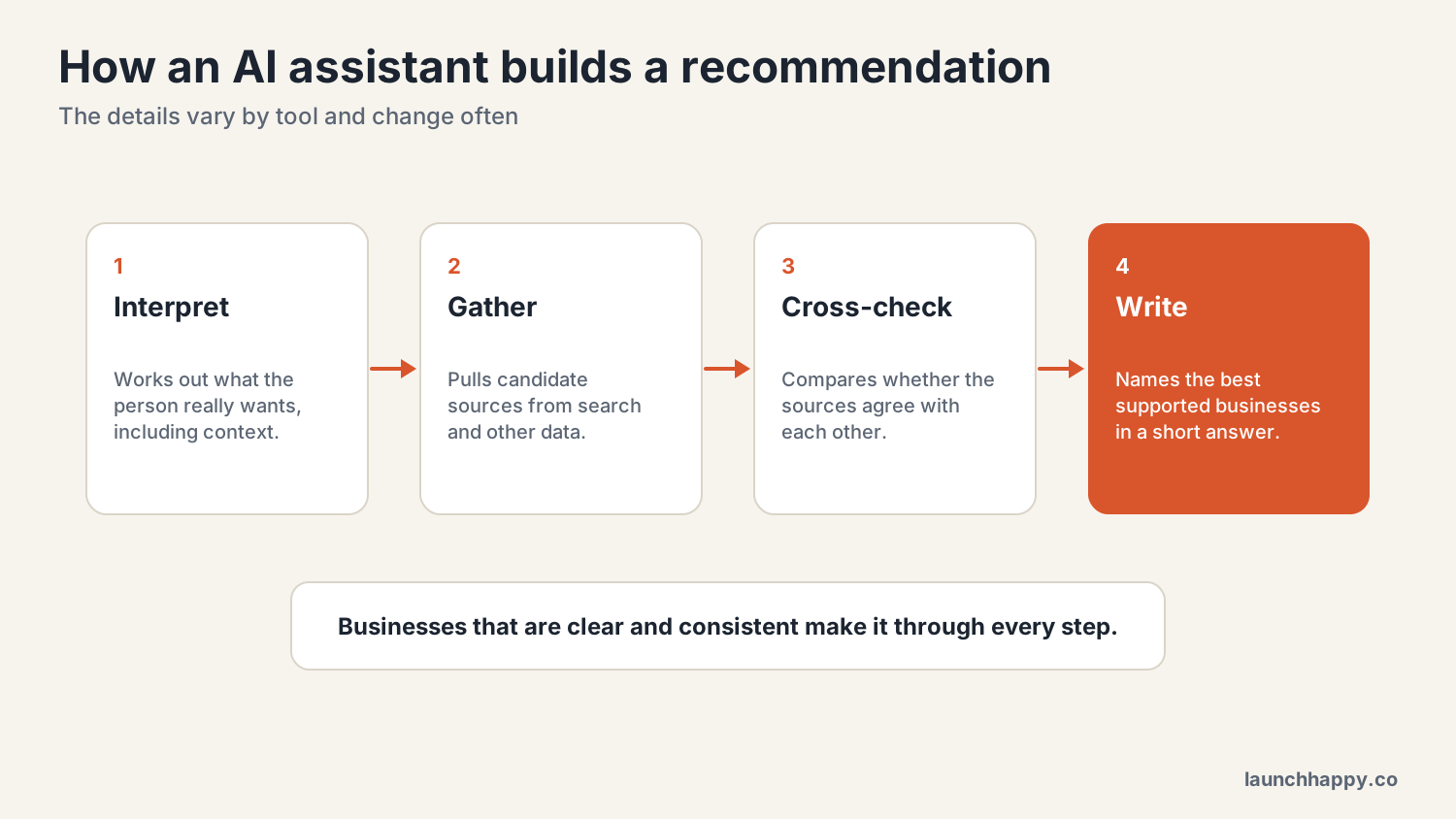
Step 1: It interprets the question. The tool works out what the person really wants, including details from earlier in the conversation. "Who is a good photographer?" is different from "Who is a good photographer for a small outdoor wedding in October?"
Step 2: It gathers candidates. Many tools search the web or a search index, and some also draw on what the model learned in training. Pages that match the question well, and are easy to retrieve, become candidates. For Google's AI features, Google says a page needs to be indexed and eligible to appear in Google Search with a snippet, and that there are no other special requirements, which you can read in Google's guidance on AI features and your website.
Step 3: It cross-checks. The tool compares what different sources say. A business that is described consistently on its own site, in directories, in reviews, and in outside mentions looks more reliable than one with conflicting details.
Step 4: It writes the answer. The tool composes a response and, in many cases, lists the sources it used. Businesses that were clear, well supported, and relevant to the specific question are the ones most likely to be named.
What signals do AI tools seem to look at?
Think of the signals in three groups: can the tool find you, can it understand you, and can it trust you.
Can it find you?
Your pages are crawlable and not blocked.
Your key content is in real text, not locked inside images.
Your site is indexed in search, since many tools lean on search results.
Can it understand you?
Each page says plainly what it is about, in the title, headings, and opening lines.
Your services, location, and audience are stated clearly.
Your pages answer the specific questions customers ask.
Structured data, where used, labels the information accurately. Google says it is not required for its AI features, but it can help machines read a page, and it needs to match what is visible.
Can it trust you?
Your business details match everywhere they appear.
You have genuine reviews and reputable mentions.
Your content shows real experience and specifics, and it is up to date.
You will notice these are the same qualities that make a site good for people. For a broader look at why the basics still matter, see SEO Isn't Dead, But It's Changing: How to Rank in Google and Get Cited by AI.
What does "cross-checking" actually look like?
This is the part most business owners underestimate, so it is worth slowing down on.
When a tool is deciding whether to name your business, it is not only reading your website. It is also, directly or indirectly, looking at what the rest of the web says about you. Think of your business as the center of a map, with several places that each tell part of the story.
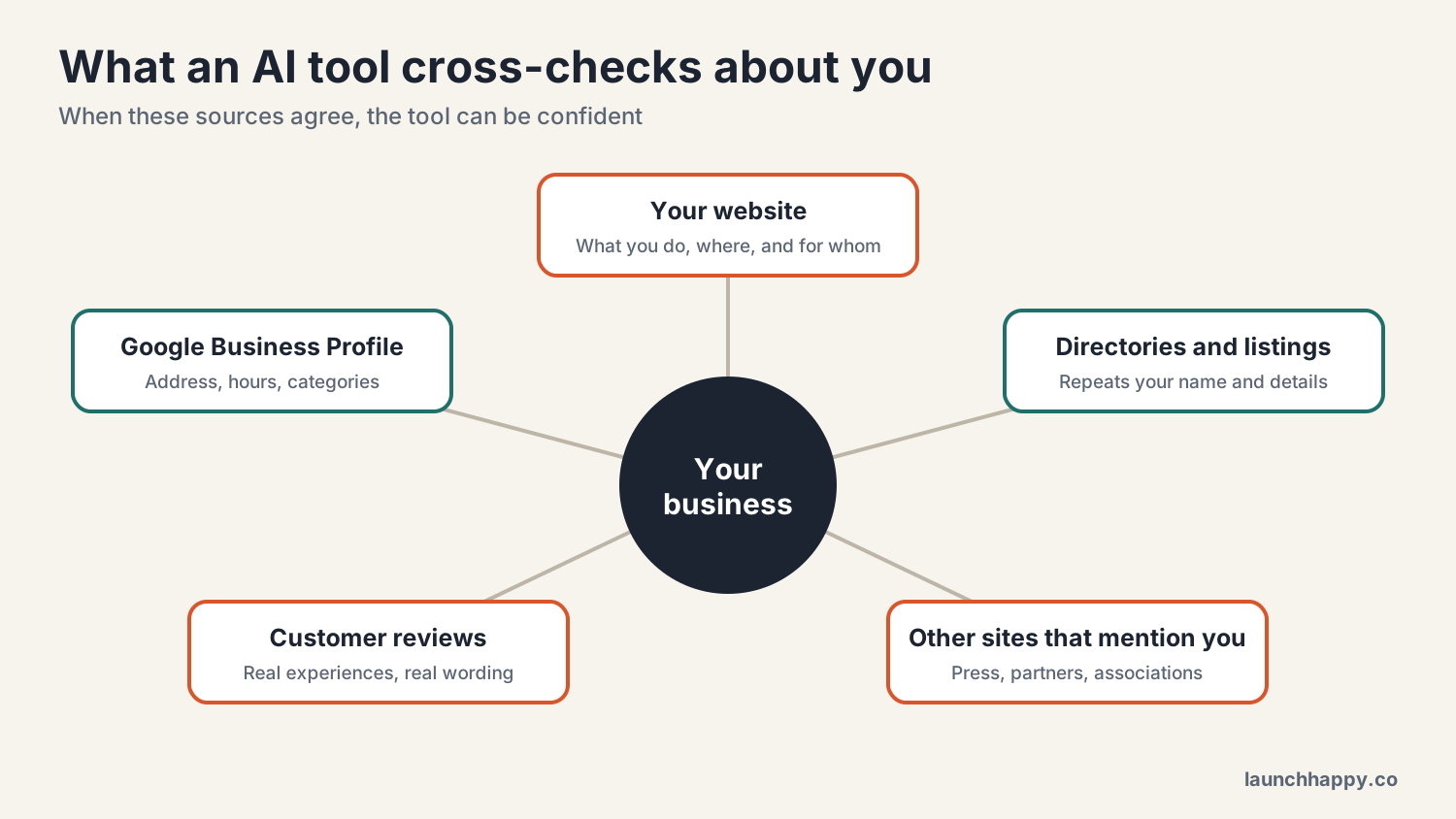
Your website. The main source of truth about what you do, where you work, who you serve, and how to contact you.
Your Google Business Profile. For local businesses especially, this is a major source of basic facts like your address, hours, and categories. Keeping it current is one of the simplest things you can do.
Directories and listings. Industry directories, local chambers, and listing sites repeat your details. When those details are outdated or different, they weaken the picture.
Reviews. Real, specific reviews show that real customers had real experiences, and they often contain the exact phrases people use to describe your service.
Other sites that mention you. Local press, partner businesses, podcasts, associations, and articles all act as independent confirmation that your business exists and does what it says.
When these sources agree, the tool can be confident. When they disagree, it may hedge, choose a competitor, or repeat wrong information.
What makes a page easy for an AI tool to use?
Beyond the signals above, the way a page is written affects how easily a tool can pull from it. Pages that perform well tend to share a few traits.
They lead with the answer. If the page is about "how long a website project takes," the answer appears in the first sentence or two, followed by detail.
They are specific. "We typically deliver a five page Squarespace site in four to six weeks" is more useful than "we work quickly." Real numbers, real processes, and real examples give a tool something to quote. Only use specifics that are true for your business.
They are organized. Clear headings written like questions, short paragraphs, and lists make it easier to find the right part of the page.
They stay current. Prices, packages, hours, and dates should reflect today, not three years ago.
They match the visitor's wording. People ask questions in everyday language. Pages that use the same words are easier to match than pages full of internal jargon.
Why does one tool recommend me and another does not?
This is one of the most common surprises. You test your business in two AI tools, and you appear in one but not the other. There are several ordinary reasons.
Different sources. One tool may lean on a particular search index or data provider that includes your site, while another does not.
Different methods. Some answers come mostly from live web results, and others lean more on training knowledge, which can be out of date.
Different phrasing. Small changes in how a question is worded can change which businesses come up.
Conversation context. Earlier messages, location, and personal settings can shape the answer.
Natural variation. The same tool can give different answers to the same question on different days.
That is why we recommend testing in more than one tool, more than once, and looking for patterns, not single results. A single missing mention is not a crisis. A consistent absence across tools and questions is a signal worth acting on.
Why do some businesses get skipped?
When a business is consistently left out, the cause is usually one of a handful of fixable problems.
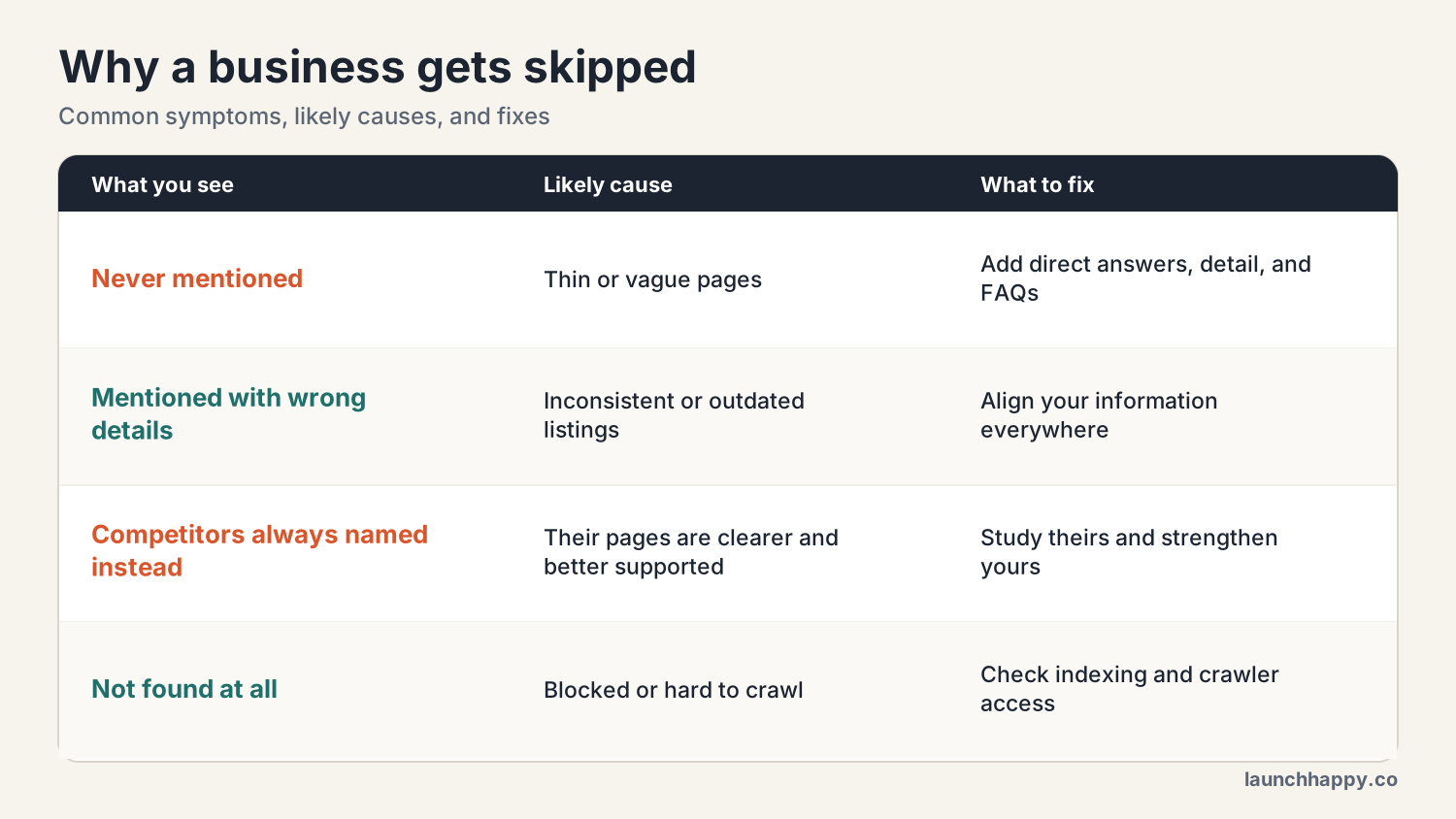
Never mentioned. Often the pages are thin or vague. Add specifics, direct answers, and FAQs that match what customers ask.
Mentioned with wrong details. This usually points to inconsistent or outdated information across your site, listings, and profiles. Align them.
Competitors keep appearing instead. Look at how their pages are structured and what questions they answer clearly. Learn from it without copying.
Not found at all. Check that your pages are indexed, that crawlers are not blocked, and that important content is not hidden inside images or behind elements that do not load for bots.
What can you not control?
It is important to be realistic. You cannot control which sources an AI tool prefers, how a model is trained, or what it says on a given day. You cannot buy a guaranteed placement, and you should be skeptical of anyone who says they can sell you one.
What you can control is the quality, clarity, and consistency of the information about your business. That is a much better place to put your energy than chasing tricks, and it is the part that tends to hold up as the tools change.
What does this look like on a Squarespace site?
On Squarespace, most of the signals above are things you can handle directly in the editor and in your site settings: SEO titles and descriptions, heading structure, plain-language service pages, FAQs, and business information. Your Google Business Profile, directory listings, and reviews live outside Squarespace, so they need their own regular check-up.
One piece that often needs more technical help is structured data, the code that labels your business, services, and FAQs for machines. We cover how it works and how to add it on Squarespace in our upcoming guide, How to Add Schema Markup to Squarespace for AI Search and Google. In the meantime, you can check your site against the eight-point list in Is Your Squarespace Site Ready for ChatGPT and AI Search?, and read Why Your Business Needs to Show Up in AI Search (Not Just Google) for the case for making the effort.
Want to see how your site measures up?
At Launch Happy, our free AI Visibility Report scores your site on the structural signals AI tools rely on, such as structured data, content depth, headings, technical health, freshness, and how clearly your business is identified. Book a free discovery call and we will run it on your site, so you have a baseline for how you show up in AI search today and know exactly where to focus. After the call, you will get a tailored proposal and quote within 2 days if you would like help with the fixes.
Frequently asked questions
How do AI assistants decide which businesses to recommend? They interpret the question, gather candidate sources, cross-check whether those sources agree, and write an answer that favors businesses that are clear and well supported. The companies do not publish exact formulas, so the signals described here are patterns, not guarantees.
Does ChatGPT use Google to find businesses? Different tools use different sources, and those sources change. Many tools use web search or a search index in some form, which is why strong traditional SEO helps. Check each tool's own documentation for current details.
Do reviews matter for AI recommendations? They appear to help. Genuine, specific reviews support your credibility and often use the same words customers use to describe what they need. Never use fake reviews, which can backfire.
Does structured data guarantee that AI tools will mention me? No. Google says no special structured data is required to appear in its AI features. Structured data can help machines understand your pages, and it should always match what is visible on the page, but it is not a switch.
Why does my business show up in one AI tool but not another? Tools use different sources, methods, and phrasing, and answers also vary from day to day. Test in more than one tool, more than once, and look for consistent patterns.
How can I improve my chances of being recommended? Make your site easy to reach, give clear direct answers to customer questions, keep your business details consistent everywhere, collect genuine reviews, and earn mentions on reputable sites. Then test regularly and adjust.
Key takeaways
No one outside the AI companies knows the exact recipe, but the tools behave in consistent ways.
Most assistants interpret the question, gather sources, cross-check them, and write an answer.
The signals fall into three groups: can they find you, understand you, and trust you.
Consistency across your website, Google Business Profile, directories, reviews, and mentions builds confidence.
Pages that lead with direct, specific, current answers are easier to use.
If you are skipped, the cause is usually fixable: vague pages, inconsistent details, or blocked access.
You cannot control the tools, but you can control the clarity and consistency of your information.
Keep reading: Why Your Business Needs to Show Up in AI Search (Not Just Google) and SEO Isn't Dead, But It's Changing: How to Rank in Google and Get Cited by AI