SEO is not dead. Google's own documentation says there are no additional requirements to appear in its AI Overviews and AI Mode beyond standard SEO best practices, and the other AI tools also rely on the same basics: pages that can be found, understood, and trusted. What is changing is the goal. Ranking in a list of links is no longer the only prize. Being named or cited in an AI-written answer is a second one, and it rewards clearer answers, better structure, and consistent business information on top of the SEO foundation you already have.
Every few months a new headline declares that SEO is over. Search is dying, AI will answer everything, nobody will click anymore. If you have spent time and money on your website's SEO, those headlines can feel like a message that all of it was wasted.
It was not. But it would also be a mistake to pretend nothing has changed. The honest picture sits in the middle, and it is more useful than either extreme.
In this post we cover where the "SEO is dead" idea comes from, what Google itself says, what actually stays the same, what is different now, and how to adjust the SEO work you are already doing so it helps with both Google and AI tools. If you are new to the term behind all this, What Is GEO (Generative Engine Optimization) and Why Your Business Needs It is a good starting point.
Is SEO dead?
No. The clearest evidence comes from Google. In its documentation for site owners on AI features, Google says that to appear in AI Overviews and AI Mode there are no additional requirements and no special optimizations needed beyond the usual. It says you do not need to create new machine readable files, AI text files, or special markup, and that there is no special schema.org structured data you must add. A page simply needs to be indexed and eligible to appear in Google Search with a snippet. You can read the guidance yourself at Google Search Central: AI features and your website.
Google's advice for those features is the same advice SEO has been giving for years: create helpful, reliable, people-first content, make sure important content is available as text, make your pages easy to find through internal links, allow crawling, give people a good page experience, and keep your business information up to date.
That does not mean nothing else matters. Other AI tools, like ChatGPT, Perplexity, Claude, and Copilot, use their own systems and do not publish exact rules. But the pattern is consistent: the sites they use and cite tend to be the ones that are clear, helpful, and easy to read.
Where does the "SEO is dead" idea come from?
There is a real shift behind the dramatic headlines, and it helps to name it.
Answers are appearing before links. Google now shows AI-written summaries above its regular results for many searches. When the summary answers the question, fewer people scroll down and click.
People are asking AI tools directly. Instead of typing a few keywords, many people now ask full questions in ChatGPT, Perplexity, Gemini, Claude, or Copilot and read the answer there.
Clicks are not the only measure anymore. A business can be mentioned in an AI answer and gain a customer who never shows up as a click from search. That makes the old scoreboard of rankings and traffic less complete than it used to be.
All of that is real. But "the way people find you is changing" is very different from "the work of making your site findable is pointless." The first is true. The second is not.
What actually stays the same?
Most of what makes a site succeed in search carries straight over to AI search. Think of it as a foundation that both depend on.
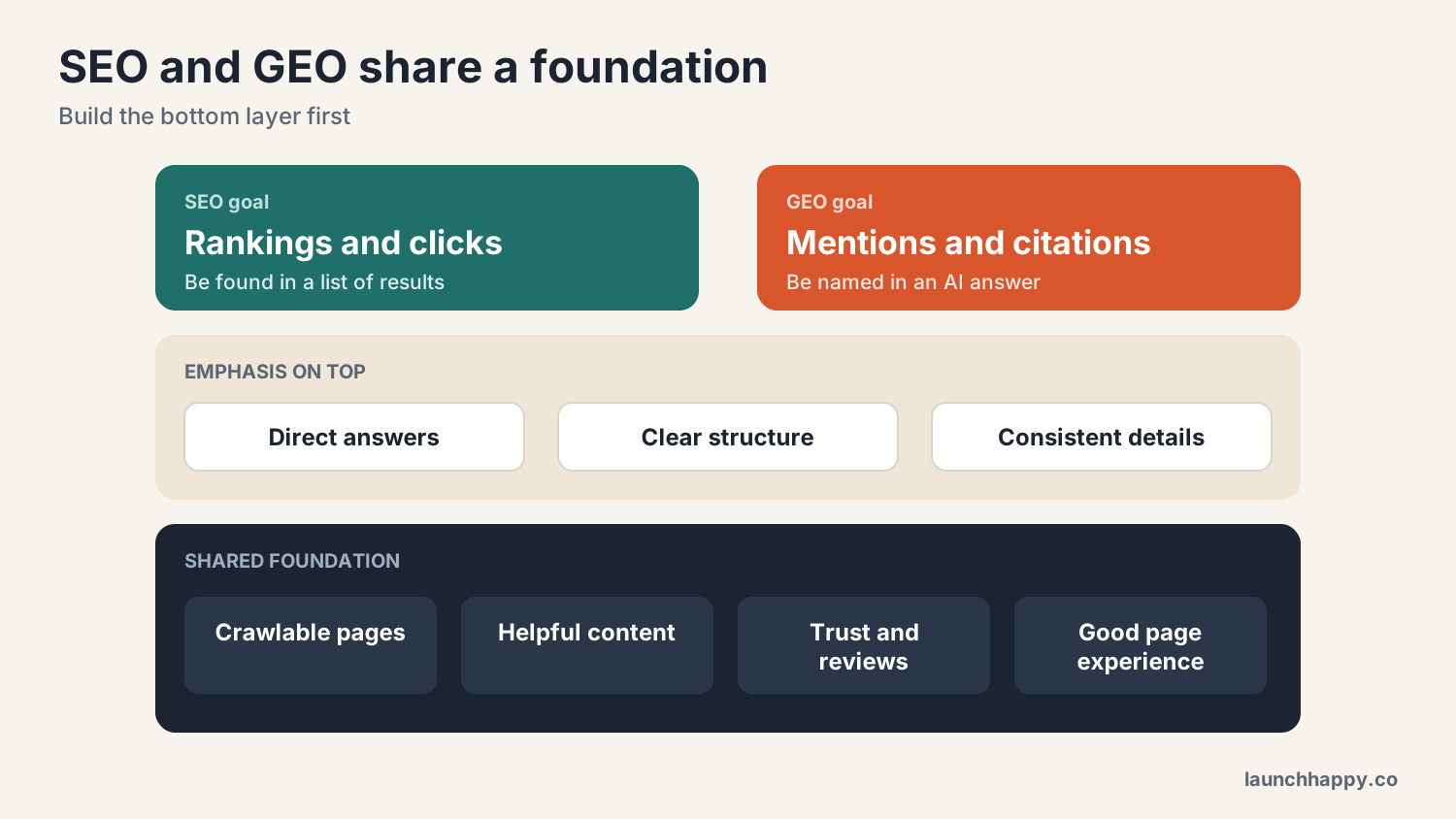
Helpful content. Pages that explain things clearly, specifically, and honestly still win, for readers and for machines.
Crawlability and indexing. If search engines cannot reach and index your pages, neither Google nor the AI tools that depend on search results can use them.
Trust. Real reviews, accurate details, a clear About page, and mentions on reputable sites all count.
Page experience. A site that loads fast, works on phones, and is easy to read serves everyone.
Internal links. Linking related pages together helps people and search engines understand how your content fits together. It is also exactly why this blog series links its posts to each other.
If you already do these things well, you are not starting over. You have a head start.
What is changing?
Here is where the shift shows up in practice.
Direct answers matter more. A page that states the answer plainly near the top is easier for an AI tool to quote than a page that buries it. Writing for the quick answer first and the detail second helps both readers and machines.
Structure matters more. Clear headings written like questions, short paragraphs, lists, tables, and FAQ sections make it easier for an AI tool to pull out the right section of a page.
Consistency across the web matters more. AI tools compare what your website says to what other places say about you. If your name, location, services, or hours differ between your website, your Google Business Profile, and directories, it creates doubt.
Mentions can matter even without clicks. Being named in an answer can bring a customer who searches your business name later or calls you directly. That makes your brand name and reputation more valuable than ever.
Measurement expands. Rankings and traffic still matter, but you also want to watch how often and how accurately AI tools mention you, and whether any visits arrive from AI tools. For a closer look at how those tools make their choices, see How AI Assistants Decide Which Businesses to Recommend.
Common myths, and what is actually true
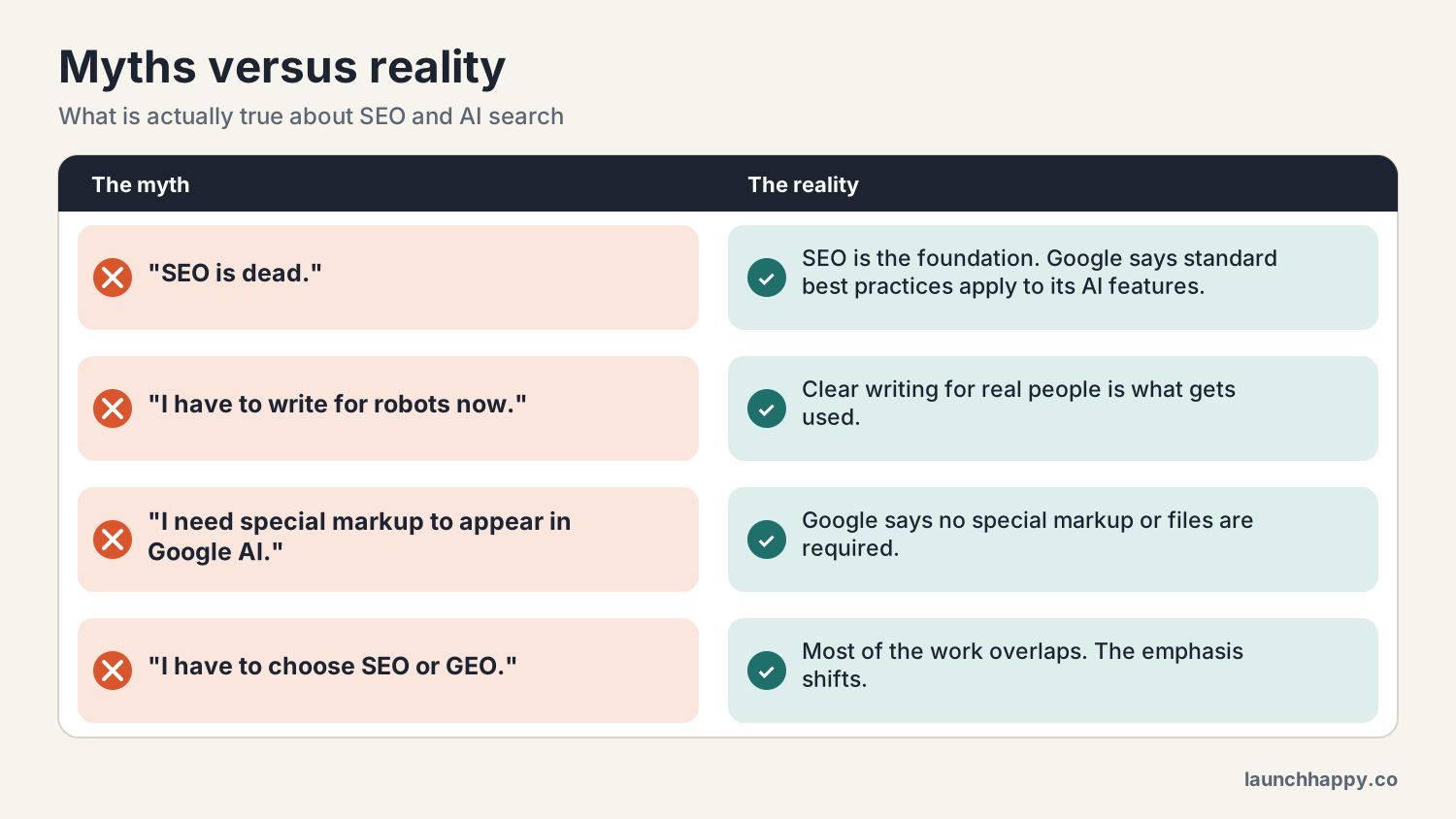
Myth: SEO is dead. Reality: Google says standard SEO best practices apply to its AI features, and many AI tools lean on search results to find sources.
Myth: I have to write for robots now. Reality: the opposite is true. The content that gets used is clear, specific, and written for a real person with a real question.
Myth: I need special markup or files to show up in Google's AI features. Reality: Google says none is required. Structured data can still help machines understand a page, but it must match what is visible on the page, and it is not a switch that turns on AI visibility.
Myth: I have to choose between SEO and GEO. Reality: most of the work overlaps. The shift is in emphasis, not in starting over.
Myth: if I do this right, AI tools will definitely mention me. Reality: no one can guarantee that. You can improve your opportunity, but the tools make their own choices.
Where does one piece of work help both?
The most encouraging part of all this is how much of the work pays off twice.
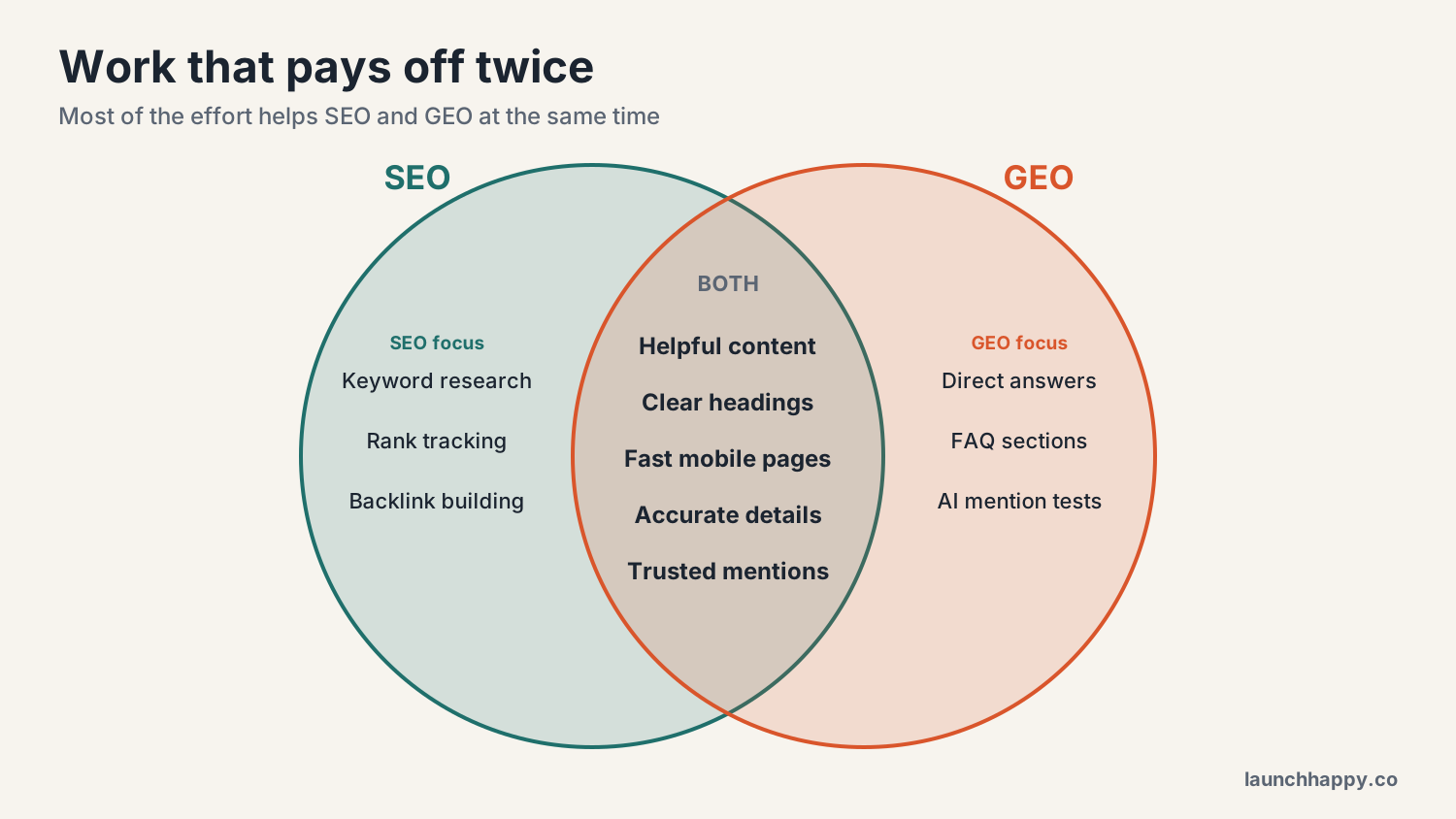
A page that gets a clear direct answer, a better heading structure, and an FAQ section is better for a Google searcher, better for a visitor who clicks through, and easier for an AI tool to quote. Cleaning up inconsistent business details helps your local search results and your AI visibility at the same time. Earning a mention on a respected site helps your rankings and your credibility with AI tools.
That is why we do not think of GEO as a separate project bolted onto SEO. It is SEO with an added focus on being understood and quoted.
What should you stop doing?
Some old habits are worth dropping, because they do not help in either world.
Stuffing keywords. Repeating a phrase over and over makes pages harder to read and does not help machines understand them.
Publishing thin pages. Short, generic pages that could describe any business in your field give nobody anything useful to quote.
Chasing tricks. Hidden text, fake reviews, and shortcuts tend to backfire, and AI tools are built to compare sources, which makes inconsistencies easier to spot.
Buying into promises. Be cautious of anyone who guarantees a spot in ChatGPT or any other AI tool. No one can promise that.
What should you add to your SEO routine?
If you already do monthly SEO work, here is how to adapt it without doubling your effort.
Add a direct answer to each key page. One or two plain sentences near the top that answer the main question the page covers.
Build FAQ sections. Base them on the real questions customers ask by email, phone, and in consultations.
Check your business details everywhere. Name, location or service area, hours, and descriptions should match across your site and your listings.
Review your key pages on a schedule. Update prices, packages, dates, and anything that has changed.
Test your visibility. Ask AI tools the questions your customers ask and note whether you appear and whether the information is right.
Check crawler access. Make sure you have not blocked the tools you want to be found by.
Track more than rankings. Add mentions, accuracy, and AI referrals to your regular reporting.
What does this look like on Squarespace?
Squarespace already handles much of the technical SEO foundation: mobile friendly templates, an automatic sitemap, and some structured data for certain page types. Your SEO work on the platform, such as page titles, descriptions, headings, image names and alt text, and internal links, all still applies, and all of it also helps with AI tools.
What is new is mostly content work inside the editor: direct answers at the top of pages, FAQ sections, and keeping business information consistent. If you want a way to check your own site step by step, our post Is Your Squarespace Site Ready for ChatGPT and AI Search? gives you an eight-point checklist, and Why Your Business Needs to Show Up in AI Search (Not Just Google) explains the business case behind it. For how the two kinds of search differ in practice, see AI Search vs. Google Search: What Small Business Owners Need to Know in 2026.
Not sure where your SEO stands for AI search?
At Launch Happy, we have worked with more than 1,000 Squarespace sites on SEO and design, and we now look at every site through both lenses. If you want a clear baseline, book a free discovery call and we will run a free AI Visibility Report on your site, so you can see how your existing SEO work translates to AI search and know exactly where to focus.
Frequently asked questions
Is SEO dead because of AI? No. Google's documentation says there are no additional requirements to appear in its AI Overviews and AI Mode beyond standard SEO best practices, and many AI tools rely on search results and well organized pages. SEO is changing in emphasis, not disappearing.
Do I need to do GEO instead of SEO? No. GEO builds on SEO. Most of the work overlaps, and a strong SEO foundation gives you a head start in AI search.
Do I need special schema or an AI text file to appear in Google's AI features? Google says no. It states that no special structured data or machine readable files are required. If you do use structured data, it should match the visible content on the page.
How is ranking in Google different from getting cited by AI? Ranking places your page in a list of results for people to click. Being cited or mentioned means an AI tool uses your page or your business name in the answer it writes. The first rewards relevance and authority for a keyword, and the second also rewards direct answers, structure, and consistency.
Will AI search reduce my website traffic? It may change it. Some answers are read without a click, while other visitors arrive already informed and ready to act. That is why it helps to measure mentions and inquiries as well as traffic.
What is the first thing I should change in my SEO approach? Add a clear, direct answer near the top of your most important pages, and make sure your business details are consistent across the web. Both help with Google and with AI tools.
Key takeaways
SEO is not dead. Google says standard best practices apply to its AI features.
What changes is the goal: a high ranking is no longer the only prize, and being named in an answer matters too.
The foundation stays the same: helpful content, crawlable pages, trust, and good page experience.
Direct answers, clear structure, consistent details, and trusted mentions deserve more attention than before.
Most SEO work pays off twice, in Google and in AI tools.
Be cautious of guarantees, since no one controls what an AI tool says.
Keep reading: Why Your Business Needs to Show Up in AI Search (Not Just Google) and How AI Assistants Decide Which Businesses to Recommend