More and more people are asking AI tools like ChatGPT, Perplexity, Gemini, Claude, and Copilot questions such as "who should I hire for this?" and getting a short written answer that names a few businesses. If yours is one of them, you are part of the decision. If it is not, a potential customer may choose without ever seeing your website, even if you rank well on Google. Showing up in AI search is not a replacement for Google. It is a second place your customers can find you, and a place where the competition is often still thin.
If you run a small business, you have probably built your visibility around Google for years. You wrote the page titles, polished the service pages, asked for reviews, and watched your rankings. That work was worth it, and most of it still is.
But something has quietly changed in how people look for help. A customer who used to type "family photographer near me" and click through a few results may now ask an AI assistant, "Who is a good family photographer in my area who is relaxed with young kids?" The assistant reads a handful of sources and replies with a short list of names and a sentence about each. Many of those customers will pick from that list and move on.
This post explains why that matters for a small business, what you stand to lose or gain, whether every business needs to care, and what you can do about it in your first month. For the full definition of the practice behind all of this, see What Is GEO (Generative Engine Optimization) and Why Your Business Needs It.
What does "showing up in AI search" actually mean?
It means that when someone asks an AI tool a question your business could answer, your business is part of the response. That can happen in three ways, and they are not equally valuable:
A mention. The assistant names your business in its answer, with or without a link.
A citation. The assistant uses your website as a source and lists it, so people can click through.
A recommendation. The assistant singles you out as a good fit for the person's specific situation.
Most businesses get mentioned long before they get recommended, and many get neither. The goal of the work in this series is to move you up that ladder by making your site easier to find, understand, and trust. There is no way to force a mention, and no honest provider can promise one. What you can do is remove the obstacles and improve your opportunity.
I already rank on Google. Why does this matter?
Ranking well on Google is a strong foundation, and it helps with AI search too, because many AI tools look at traditional search results when they gather sources. But there are three reasons a good Google ranking is no longer the whole story.
1. The answer can replace the click. When an AI tool writes a complete answer, some people never open a website. They read the summary, pick a name, and look that business up directly or contact them. If you are not in the summary, you were not considered.
2. The list is shorter. A page of Google results can show ten links, and a person might look at several. An AI answer often names just a few businesses. Being one of three matters far more than being number seven out of ten.
3. The line between Google and AI search is blurring. Google now places AI-written summaries above its regular results for many searches, so even people who "just use Google" are reading AI answers. If you want the side-by-side breakdown of how the two work, we explain it in AI Search vs. Google Search: What Small Business Owners Need to Know in 2026.
How does AI search change the customer journey?
The old path was simple: search, scan results, click a few websites, decide. The new path often has an extra step at the front, where the AI assistant narrows the field before the customer ever visits a site.
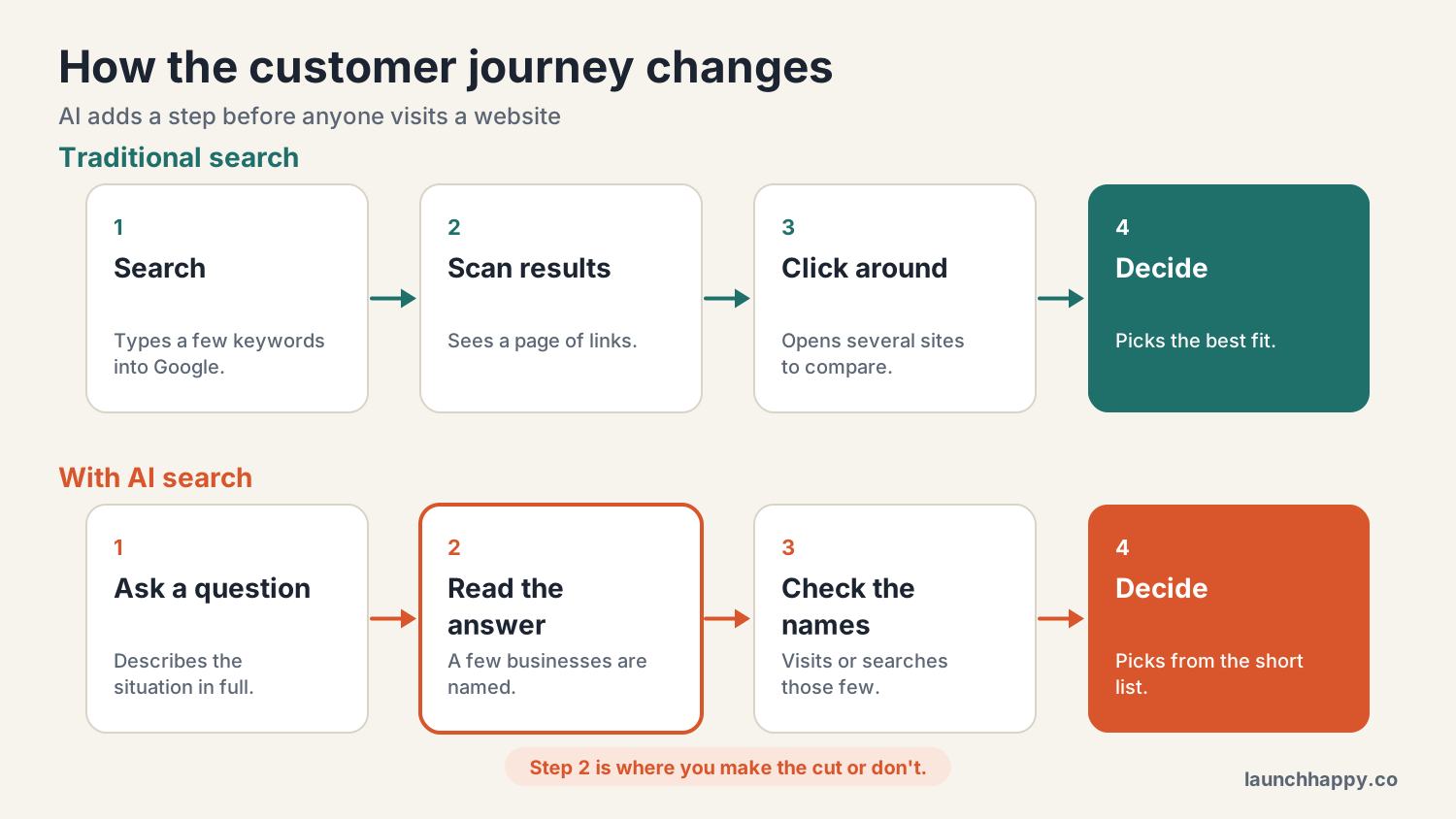
Notice what that means for you. In the traditional path, you could win a customer by having a better page than the competitor three spots above you. In the AI path, the field has already been narrowed by the time anyone looks at a page. The question becomes whether you made the cut.
The customer also arrives differently. Someone who heard your name from an AI assistant may search for you directly, visit your site with a specific question in mind, or call. That is why consistent business details and a clear, honest website matter so much. The person already has an impression of you before they land on the page.
What does this look like for real businesses?
Here are three everyday examples. They are illustrations, not case studies, but they reflect the kinds of questions people ask.
A wedding photographer. A couple asks, "Who are some good wedding photographers in Nashville who shoot film?" An assistant replies with three studios and a line about each. A photographer whose site clearly says "film wedding photography in Nashville" in plain text, with packages and a short FAQ, gives the assistant something to work with. A photographer whose site is mostly beautiful images with a few vague lines gives it very little.
A small accounting firm. An owner asks, "What should I look for in an accountant for a new LLC, and who is good near Austin?" The assistant explains what to look for and may name firms. A firm that has a clear page on new business setup, written in plain language, with pricing explained and a few common questions answered, is easier to include than a firm with a single "Services" page listing the word "tax" a few times.
A neighborhood fitness studio. Someone asks, "Where can I find a beginner-friendly small group fitness class near me?" The assistant leans on information it can verify, like location details, class descriptions, and reviews. If the studio's hours and address differ across its website, its Google listing, and a directory, the assistant has a harder time being confident.
In each case, the winner is not necessarily the best business. It is the business that is easiest to understand and verify. That is good news for small businesses, because clarity is something you control.
What do you lose if you ignore AI search?
It is worth being honest here. Most small businesses will not lose everything overnight, and no one can say exactly how fast AI search will grow. But there are real risks to waiting.
You may be missing from the shortlist. If your competitors are clearer to the assistant, they get named and you do not, and you may never know it happened.
You may be described wrongly. AI tools sometimes repeat outdated or inaccurate details, such as an old address, a retired service, or incorrect pricing. If you never check, you cannot fix it.
You lose the head start. Many businesses are not paying attention to this yet. The ones that adjust early often find that straightforward improvements go a long way.
You may be invisible by accident. Some sites block AI crawlers through a setting nobody remembers changing, or hide key information inside images. Those are fixable problems, but only if you look.
None of this means AI search will replace your current marketing. It means this is a channel worth checking on, and an inexpensive one to prepare for.
Why a short list matters more than ten blue links
When you appear on a results page, you are competing for attention with many other listings, and each one gets a small share. When an AI assistant names three businesses, each one gets a much larger share of the person's attention, because there are fewer to consider.
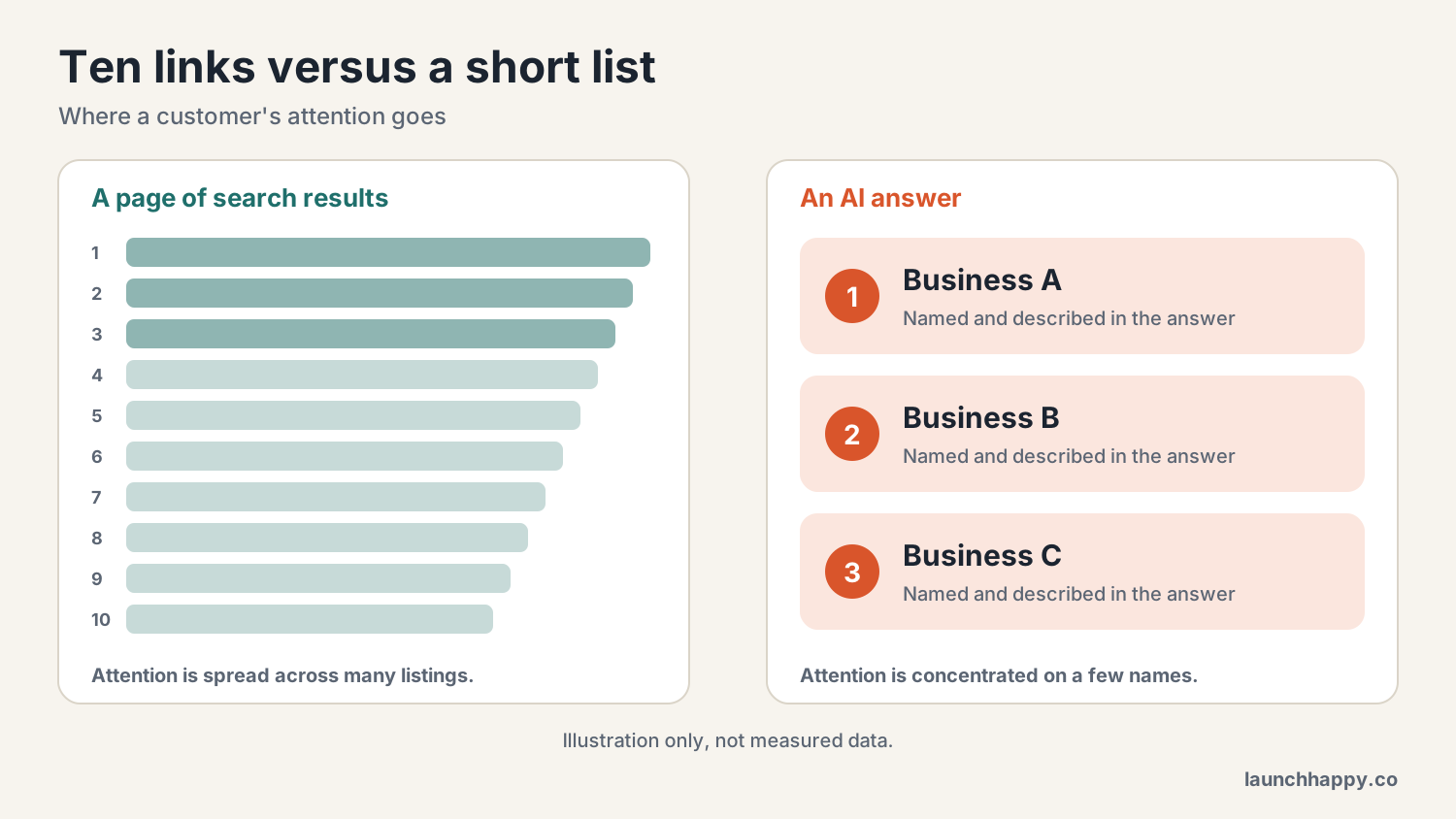
That cuts both ways. The reward for being on the list is higher, and the cost of being left off is higher too. It is also why small details, like a clear service description or a consistent business name, can make an outsized difference.
Does every business need to care about AI search?
Not equally, and it is worth saying so plainly.
AI search matters most for businesses whose customers research before they buy: service providers, consultants, creative studios, health and wellness practices, professional services, local services, and anyone selling something that takes a decision. It also matters if your customers are early adopters of new tools.
It matters less, at least right now, if nearly all your business comes through word of mouth from a small, stable network, or if customers find you by walking past your door. Even then, it costs little to make sure the information AI tools show about you is correct.
A useful test: ask yourself whether a customer might type or say a question like "who should I hire for [your service]?" If the answer is yes, someone is probably asking it of an AI tool already.
What does it cost to get started?
For most small businesses, the first steps cost time more than money. Checking how you appear, rewriting vague pages in plain language, adding FAQs, and cleaning up inconsistent business details are all things you can do yourself. The parts that benefit from help are usually technical, like structured data and a full audit of how your site looks to crawlers.
The good news is that the same work improves your regular SEO, so it does not compete with what you are already doing. It sharpens it.
Your first 30 days: a simple plan
You do not need to do everything at once. Here is a realistic first month.
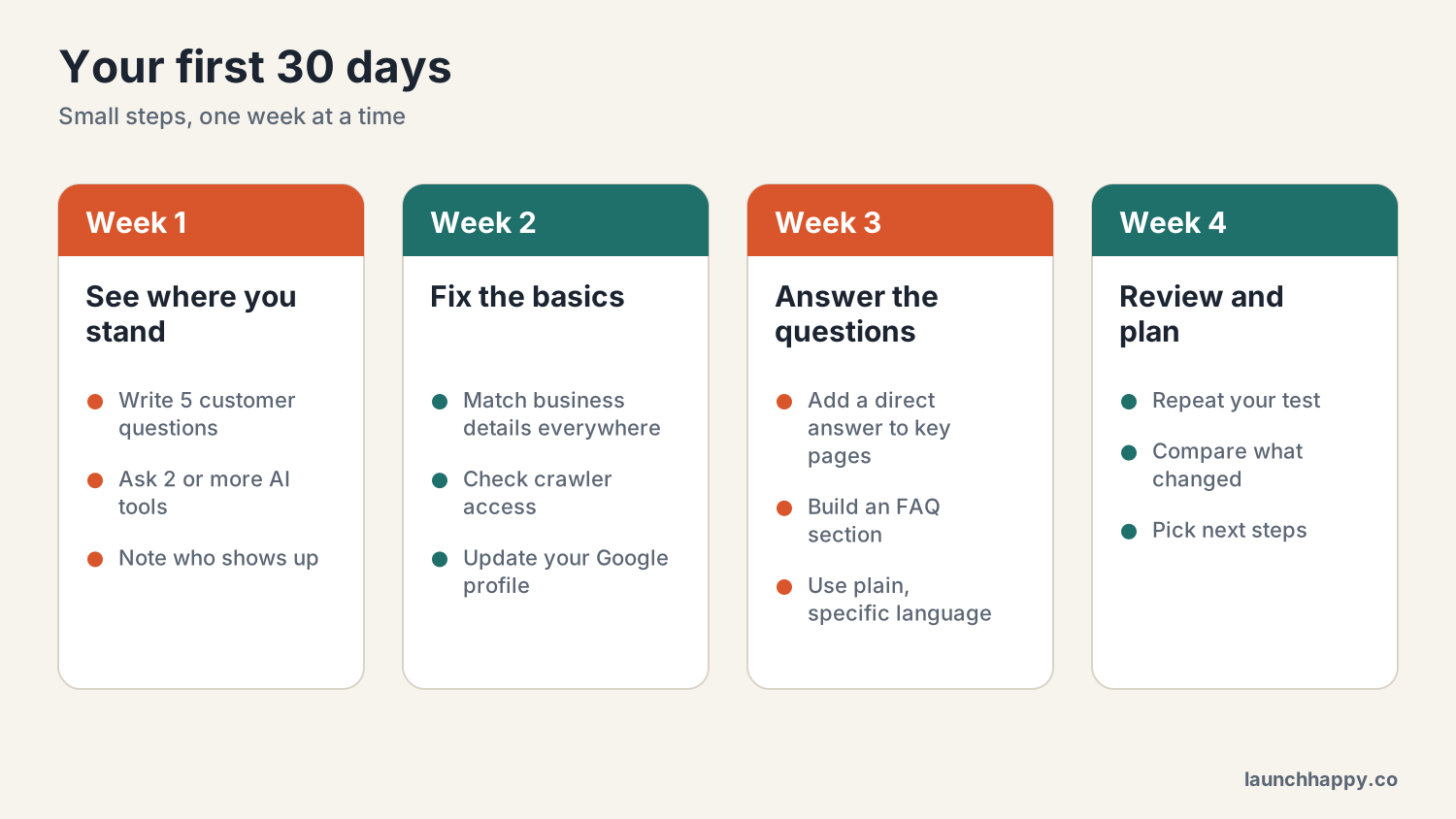
Week 1: See where you stand. Write down five questions your ideal customer would ask. Ask each one in at least two AI tools. Note whether you appear, whether the details are right, and who shows up instead.
Week 2: Fix the basics. Make your business name, location or service area, hours, and description consistent across your website, Google Business Profile, social profiles, and directories. Check that nothing is blocking the crawlers you want to reach you.
Week 3: Answer the questions. Pick your two or three most important pages. Add a short, plain answer near the top of each, and add an FAQ section based on what customers really ask.
Week 4: Review and plan. Repeat your test and compare. Note what changed, and decide which bigger steps, like structured data or new supporting content, are worth doing next.
What does this look like on a Squarespace site?
Squarespace gives you a good technical base, with mobile friendly templates and an automatic sitemap. The work that is left is mostly editing: SEO titles and descriptions for each page, clear headings, plain-language service descriptions, FAQ sections, and accurate business information in your site settings. Everything in the 30 day plan above can be done inside Squarespace without code.
If you want a step-by-step way to check your own site, our post Is Your Squarespace Site Ready for ChatGPT and AI Search? walks through an eight-point checklist. To understand what AI tools actually look at when they pick businesses, read How AI Assistants Decide Which Businesses to Recommend. And if you are worried that this means your SEO work has been wasted, SEO Isn't Dead, But It's Changing explains why it has not.
Want to see how your site shows up today?
At Launch Happy, we offer a free AI Visibility Report that scores your site on the structural signals AI tools rely on and shows where the biggest gaps are. Book a free discovery call and we will run it for you, so you have a baseline for how your site is set up for AI search today and know exactly where to focus. After the call, we can send you a tailored proposal and quote within 2 days if you would like help with the fixes.
Frequently asked questions
Why does my business need to show up in AI search? Because a growing number of people ask AI tools who to hire or where to go, and those tools often name just a few businesses. If yours is not one of them, you may not be considered at all, even if you rank well on Google.
Is AI search going to replace Google? Not entirely, and no one can say for sure how it will develop. Many people still use Google for many kinds of searches, and Google now shows AI summaries itself. The safest approach is to make your site work well for both.
If I rank on Google, will I automatically show up in ChatGPT? No, but it helps. Many AI tools look at traditional search results when gathering sources, so a strong site has a head start. Still, AI tools also weigh clarity, consistency, and trust, so it is worth checking directly.
How do I know if AI tools mention my business? Ask the questions your customers would ask in more than one AI tool and see whether you appear and whether the details are accurate. Repeat the test monthly, since answers change.
Can a small business really compete with bigger companies in AI search? Yes, in many cases. AI tools do not care about your marketing budget. They respond to how clearly your site explains who you are, what you do, and who you serve, and a well organized small site can beat a larger company's messy one.
Can anyone guarantee that an AI tool will recommend my business? No. The tools change often and do not publish exact rules. What you can do is improve your opportunity by making your business easy to find, understand, and trust.
Key takeaways
People increasingly ask AI tools who to hire, and the answer often names only a few businesses.
Ranking on Google helps, but it no longer guarantees you are considered.
Being left off a short list costs more than being ranked lower on a long one.
Clarity wins. The business that is easiest to understand and verify often gets named.
Most first steps cost time, not money, and they improve your regular SEO too.
Start with a simple test, fix your business details, and add direct answers to your key pages.
Keep reading: SEO Isn't Dead, But It's Changing: How to Rank in Google and Get Cited by AI and How AI Assistants Decide Which Businesses to Recommend