Which Schema Types Matter Most for AI Search?
If you want the short version: Organization first, Article second, everything else a distant third, and no schema type has been shown to cause an AI citation. Google's own AI features documentation states there are no additional requirements to appear in AI Overviews or AI Mode, and that there is no special schema.org structured data you need to add [2]. The most rigorous independent analysis available, Zyppy's May 2026 meta-analysis of 54 experiments, patents and case studies, scored ranking-related factors at the top and found no strong evidence for markup as a citation driver [10]. Program research that fully parameterised 49 pages which had genuinely earned AI citations found JSON-LD on zero of them [31]. So the ranking below is a ranking of usefulness, not of citation power — because the honest evidence does not support a citation-power ranking at all.

Figure 1: Every measured cited page lacked schema
Why most "best schema for AI" lists are unreliable
Almost every list of schema types for AI search shares three problems.
They are ordered by preference, not evidence. The author's ranking reflects what they have implemented, not what has been tested. Until May 2026 there was no published attempt to weight AI-citation advice by strength of evidence; Zyppy's meta-analysis was the first, synthesising 54 experiments, patents and case studies into 23 scored factors [10].
They still recommend FAQPage first. This was standard advice for years, and it is now out of date in an important way. Google restricted FAQ rich results to well-known authoritative government and health sites in August 2023 [5], then on 7 May 2026 stopped showing them in Google Search entirely, removing the Search Console report and Rich Results Test support in June 2026 and API support in August 2026 [1]. Any list that leads with FAQ schema for the rich result is selling a feature that no longer exists.
They omit what Google actually said. The single most relevant sentence for anyone deciding where to spend markup budget is Google's statement that no special schema.org structured data is needed for its AI features, and that you do not need to create new machine-readable files, AI text files, or markup [2]. A recommendation that withholds this from the reader is not giving them what they need to decide.
This article states the evidence first and the recommendation second, so you can disagree with the recommendation while keeping the evidence.
What "matters" should mean here
Before the ranking, it is worth being precise about the question, because "which schema types matter most for AI search" bundles three different questions that have three different answers.
Does this type make my page eligible for something? For a handful of types the answer is a clear yes and it is measurable in Search Console. Product, Recipe, Event, JobPosting and LocalBusiness still drive visible features. This is classic SEO and its value is unchanged by anything happening in AI search.
Does this type help a machine understand my page correctly? Almost all valid markup does this to some degree, and Organization does it best, because identity is the thing machines most often get wrong. A business with a common name, a recent rebrand, or a similarly-named competitor is genuinely ambiguous to a reader encountering it cold.
Does this type cause an AI assistant to cite me? This is what most people mean when they ask, and it is the one with no supporting evidence. Google says no special markup is required for its AI features [2]; the best-evidenced independent analysis does not rank markup among its top factors [10]; and a measured sample of 49 pages that had actually earned citations found schema on none of them [31].
Keeping the three questions apart is what allows an honest recommendation. Markup is worth implementing for the first two reasons. It is not worth buying for the third, and a proposal that prices it as an AI-visibility service should be read carefully.
What the evidence actually ranks
Zyppy's scored analysis is the closest thing the field has to a weighted consensus. Its top factors were search rank at 9.4, query fan-out rank at 9.3, preview control at 9.2, and topic-cluster ranking at 8.9 [10]. Structured data does not appear near the top of that list. llms.txt — the other machine-readable file widely recommended for AI visibility — scored 2.0 out of 10, with the assessment that there is no credible evidence it influences AI citations [10].

Figure 2: AI citation factors, weighted by evidence
Two of those top factors deserve unpacking, because they are not what most people optimise.
Query fan-out. Google's documentation confirms AI Overviews and AI Mode may use a "query fan-out" technique, issuing multiple related searches across subtopics and data sources to build a response, and that this allows a wider and more diverse set of links to be displayed than in classic search [2]. The practical consequence is that a page ranking for many related queries across a topic cluster gets disproportionate exposure, which is why topic-cluster ranking scores so highly [10]. Depth in one subject beats breadth across many.
Preview control. This is the overlooked one and it is the only technical setting on the list that can actively destroy your visibility. Pages using a nosnippet directive to suppress preview snippets can inadvertently reduce or eliminate AI citation visibility, because AI systems lean on snippet data when grounding [10]. Google confirms nosnippet, data-nosnippet, max-snippet and noindex are the controls that limit what is shown from your pages [2]. If someone on your team added nosnippet years ago for scraping reasons, that is worth checking before you spend a day on markup.
For completeness, the academic baseline points the same direction. The Princeton-led GEO paper at KDD 2024 tested nine content modifications across roughly 10,000 queries and found the strongest were adding statistics, adding quotations from credible sources, and citing sources, producing 30–40% relative improvement on its primary metric [6]. The widely-quoted "40%" is a maximum, not an average [6]. Keyword stuffing performed worse than baseline [6]. And C-SEO Bench, the first systematic benchmark of conversational-SEO tactics, found most such tactics do not help and several hurt, while plain source relevance keeps working [7].
None of those nine tested modifications was a schema type.
The ranking, with reasons
1. Organization: The entity layer
If you implement one type, implement this one.
Organization states who is behind the site: name, canonical URL, logo, description, and sameAs links to verified profiles [30]. It is the only common markup type whose job is entity disambiguation — telling a machine unambiguously which company is speaking, and distinguishing you from every similarly-named business.
The supporting evidence here is indirect but consistent. In program research, the single most-cited page across an entire measured model was an entity-definition page — a plain-language statement of what the brand is and who it belongs to — which earned 30 citations on its own, more than any other single page [31]. Entity clarity was doing that work. Organization markup is the cheapest machine-readable expression of the same thing.
It is also the type least likely to be deprecated, because it does not depend on a SERP feature. It describes a fact.
The sameAs property deserves specific attention, because it is the part most often left empty. sameAs accepts the URLs of your verified profiles elsewhere — the company's own entries on the platforms where it is independently listed [30]. Its function is corroboration: it links the entity described on your site to the same entity described somewhere you do not control. For a small business competing against larger namesakes, that corroboration is the difference between being a recognised entity and being an unresolved string.
There is a natural pairing here with content. Markup states the identity; an entity-definition page explains it in prose. The measured research suggests the prose page is what actually gets cited [31], with the markup supporting rather than replacing it. Do both, and keep them consistent — Google's one piece of structured-data advice in the AI context is that markup should match the visible text [2].
2. Article: The content layer
Headline, description, datePublished, author, publisher, mainEntityOfPage. Unglamorous and stable.
Its main practical value is date clarity. Freshness appears repeatedly in citation research: ConvertMate's AI Visibility Study, covering 80 million citations across more than 10,000 domains, reported that content updated within the last 90 days received roughly a 3.2x citation multiplier [18]. If a machine reader cannot establish when your page was last meaningfully updated, it cannot apply that preference in your favour. An explicit datePublished and dateModified remove the ambiguity.
A warning attached to this one: do not touch dateModified unless the content genuinely changed. Restamping unchanged pages to look fresh is the kind of tactic C-SEO Bench found does not work and can hurt [7], and it corrodes the only signal you were trying to send.
3. FAQPage: Valid, harmless, no longer a rich result
Ship it on genuine FAQ sections. Do not expect anything from it.
FAQPage remains a valid Schema.org type [29], Google has said unused structured data does not cause problems for Search and there is no need to proactively remove it [5], and a controlled SearchPilot test found removing FAQPage markup produced no statistically significant traffic change [25]. That last figure is the honest summary of its current value: measurably neutral.
What still works is the FAQ content shape — short, self-contained, question-led answers. That is a writing decision, not a markup decision, and we cover the implementation in How to Add FAQ Schema to a Website (Step by Step).
Note also that QAPage, for pages where users submit multiple answers to one question, is a different type and was not part of the deprecation [26].
4. Type-specific markup where a live rich result exists
Product, Recipe, Event, JobPosting, LocalBusiness, Review. If your business genuinely has products, events or physical locations, these types still drive visible search features and are worth implementing properly.
This is ordinary SEO rather than AI optimisation, and it should be budgeted as such. The rich results are real, they are measurable in Search Console, and they have nothing to do with whether ChatGPT cites you.
It is worth naming the trap in this category, because it has now caught the industry twice. A rich result is a product decision, and product decisions get reversed. HowTo was restricted to desktop in August 2023 and then withdrawn entirely [5]; FAQ was restricted in the same announcement and removed in May 2026 [1][5]. Both had thriving cottage industries of tutorials, plugins and agency line-items attached to them. Implement type-specific markup because the feature is live and useful today, and structure the work so that losing the feature costs you an afternoon rather than a strategy.

Figure 3: A rich result is a rented asset
5. Everything else: Implement only if true
Speakable, HowTo (rich result already removed on mobile and then withdrawn [5]), Dataset, Course. Add them when they accurately describe your page. Adding them speculatively violates the requirement that markup accurately represent the page [4].
Not recommended: llms.txt
It is not schema, but it is invariably on the same list, so it belongs in the ranking. Proposed by Jeremy Howard of Answer.AI on 3 September 2024, llms.txt is a markdown file at a site's root giving language models a curated map of the site, originally motivated by context-window limits and the cost of converting HTML into clean text for developer documentation [20][21].
The adoption evidence is poor. Reporting through 2025 and 2026 indicates no major AI provider has committed to consuming third-party llms.txt files, server-log evidence shows AI crawlers largely do not request them, adoption sits at roughly 2.13% of sites, and about 39.6% of the files that exist are plugin-generated stubs [22][23]. Zyppy scored it 2.0 out of 10 [10]. Google's AI documentation says explicitly you do not need to create new machine-readable files or AI text files [2].
Write one if you publish developer documentation and want a clean entry point for coding assistants. That is the use case it was designed for [20]. It is not a visibility strategy.
The rule that governs all of them
One requirement outranks the entire ranking above: markup must accurately represent the page [4].
Google's guidelines prohibit marking up content not visible to readers, marking up irrelevant or misleading content, and using structured data to deceive [4]. In its AI guidance the same point reappears in the one piece of structured-data advice Google does give for AI features: make sure your structured data matches the visible text on the page [2].
The practical failure mode is not deliberate deception. It is plugins emitting properties the page does not support - an aggregateRating where there are no reviews, an author where there is no byline, an Organization logo that 404s. Audit what your CMS actually emits rather than assuming it is correct. A small true block beats a large aspirational one, every time.
What to do instead, ranked by evidence
If your goal is AI visibility rather than markup completeness, the ranked list looks different and it is mostly not technical.
Mirror the question in the title. In the LaunchHappy Panel B measurement — 25 frozen GEO questions across four AI platforms, three runs each, for 300 measured answers — 2,026 cited references were logged, and 86.3% pointed to pages whose title or slug restated the query [32]. This is the largest single pattern in that dataset by a wide margin.

Figure 4: The largest single pattern in the data
Answer in the opening block. Zyppy and Authoritas found 44.2% of all LLM citations are extracted from the first 30% of a document [11]. An answer in section four may as well not exist.
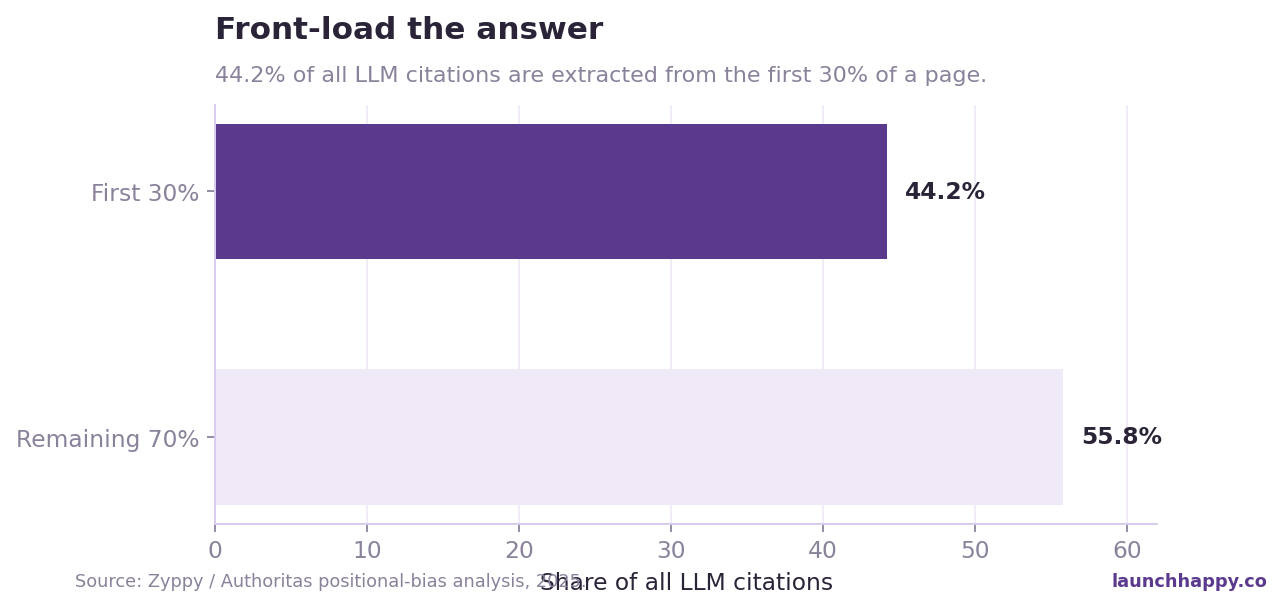
Figure 5: Front-load the answer
Write in extractable units. In the same Panel B run, 32.5% of citations were passage-level deep links using the #:~:text= fragment syntax — the assistant quoting one specific block rather than citing the page as a whole [32]. Follow each heading with a short answer that survives being lifted out of context.
Add statistics, quotations and citations. These were the three highest-performing modifications in the KDD 2024 study [6], and they are the rare tactic that C-SEO Bench's corrective does not undercut, because they improve the source rather than gaming the response [7].
Keep ranking. Zyppy scored search rank highest at 9.4 [10]. The relationship is weakening — Ahrefs data indicates AI Overview citations from top-10 organic results fell from roughly 76% in July 2025 to 38% in March 2026 [9], and BrightEdge put the figure at 17% in February 2026 [14] — but weakening is not the same as gone, and the two sources disagreeing is a reminder of how young this measurement field is.
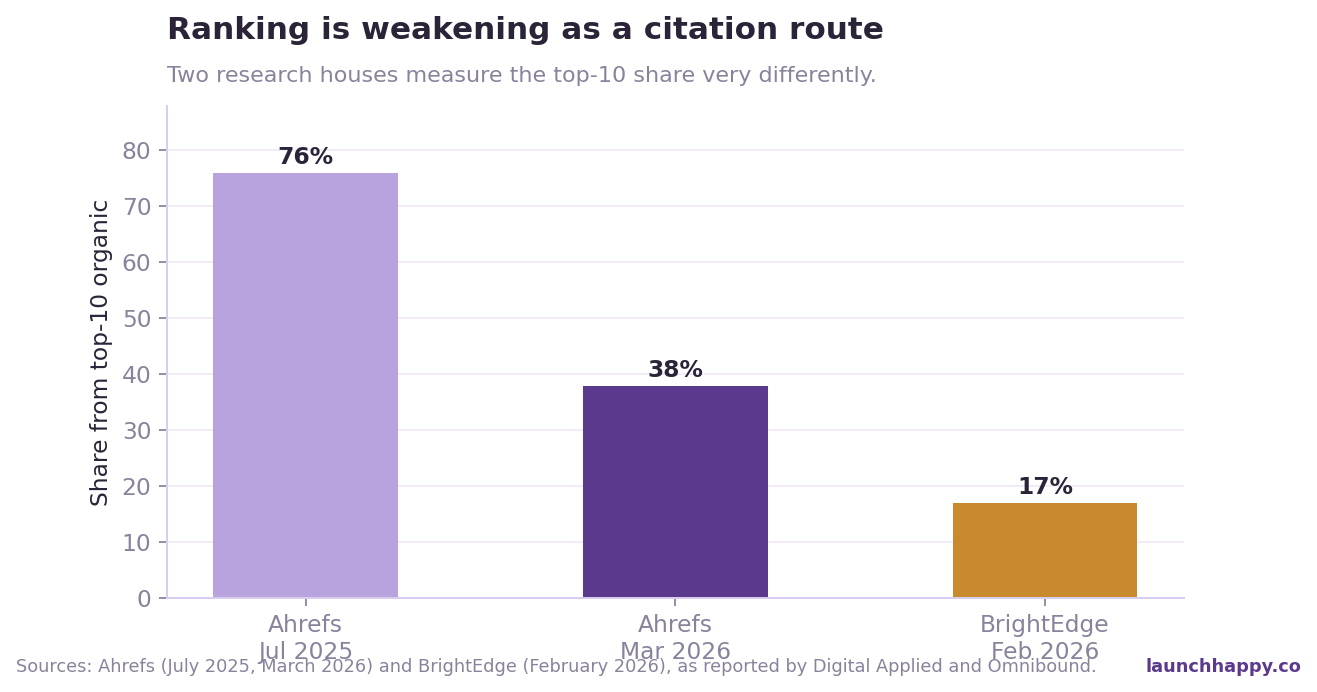
Figure 6: Ranking is weakening as a citation route
Check your preview controls. A nosnippet directive can suppress the snippet data AI systems ground on [10][2]. This is a five-minute check with a large downside.
Publish depth in one subject rather than breadth across many. Because AI features fan a question out into multiple related searches [2], a site that ranks across a whole cluster is retrieved far more often than a site with one strong page and nothing around it. Growth Memo found the top 10 domains take 46% of all ChatGPT citations within a topic, and the top 30 take 67% [17] — concentration that is real, but concentration within a topic, which is precisely why a narrow well-owned subject is a viable entry point for a small site.

Figure 7: Citations concentrate — but within a topic
Make sure you are crawlable at all. Google's stated technical requirement for appearing in AI Overviews or AI Mode is that a page be indexed and eligible to be shown in Search with a snippet, with no additional technical requirements beyond that [2]. Crawling has to be allowed in robots.txt and by any CDN or hosting layer in front of the site [2]. It is worth confirming rather than assuming, particularly on sites where a bot-blocking rule was added at some point by someone who has since left.
The mechanism behind all of this is set out in Why Does AI Cite Some Websites and Not Others?, and the format itself is explained from scratch in What Is JSON-LD Structured Data? A Plain-English Guide.
A defensible implementation, in priority order
For a small business site, this is roughly a morning's work and will not need revisiting when the next rich result is retired.
Organization, site-wide. Name, URL, logo, description, sameAs [30].
Article on every post. With honest datePublished and dateModified.
FAQPage on real FAQ sections only [1][29].
Type-specific markup where you have the thing — products, events, locations.
Confirm no nosnippet is suppressing your snippets [2][10].
Confirm markup is in the served HTML. Google renders JavaScript in a deferred phase [27], and many retrieval crawlers execute far less JavaScript than Googlebot does.
Stop. Do not add types you cannot substantiate on the page [4].
Then leave it alone. Structured data is infrastructure, not a campaign: it wants to be correct and stable rather than continuously optimised. The recurring work is content — mirroring real questions, answering them in the opening block, keeping pages genuinely current — and that is where the remaining budget should go.
A closing note on expectations. Only about 14% of marketers currently track AI search performance at all [19], which means most organisations are making markup decisions with no measurement attached to them. If you are going to spend on this, spend a fraction of it on knowing whether it worked: pick a fixed set of questions, record what the assistants answer today, change one thing, and re-run the same questions later. A measured null result is worth more than an unmeasured belief, in either direction.

Figure 8: Most markup decisions are made without measurement
How to tell a good markup proposal from a bad one
If you are buying this work rather than doing it, four questions separate a defensible proposal from an expensive one.
"What will this change, and how will we know?" A good answer names a measurable outcome — eligibility for a specific rich result, a Search Console report that will populate, an ambiguity in how the business is identified that will be resolved. A bad answer is "AI visibility" with no measurement attached.
"What is your evidence that markup affects AI citations?" The honest answer today is that there isn't strong public evidence, and a supplier who says so is more trustworthy than one who does not. Google states no special schema.org structured data is needed for its AI features [2]; the leading scored analysis does not place markup among its top factors [10]; and a measured sample of cited pages found schema on none of them [31].
"Which of these types is tied to a rich result that currently exists?" This is the question that would have prevented most of the FAQ-schema spend of the last three years [1][5]. Features get withdrawn. Ask which line items depend on one.
"Will the markup match what is actually on the page?" Accuracy is a hard requirement, not a nicety [4], and auto-generated markup routinely fails it. Ask to see what the plugin emits on a real page.
None of this means the work is not worth doing. It means it is worth roughly what a careful hour of technical hygiene is worth, and it should be priced and described that way.
Frequently asked questions
Which schema type is best for AI search? No schema type has been shown to cause AI citations. Google states no special schema.org structured data is needed for its AI features [2]. If you implement one type for general usefulness, make it Organization, because it disambiguates who you are [30].
Does schema markup help AI find my content? It helps machines parse claims your page already makes. It is not a discovery mechanism. Being crawlable, indexed and eligible to be shown with a snippet is what makes a page eligible to appear in Google's AI features [2].
Is FAQ schema still worth adding? It is valid and harmless but no longer produces a rich result in Google as of 7 May 2026 [1]. A controlled SearchPilot test found removing it produced no statistically significant traffic change [25]. Add it if you have a genuine FAQ section; do not build a business case on it.
Should I add llms.txt? Only if you publish developer documentation and want a clean entry point for coding assistants — the use case it was designed for [20]. No major AI provider has committed to consuming third-party files, and Zyppy scored it 2.0 out of 10 on evidence strength [10][22][23].
Does more schema mean better results? No. Markup must accurately represent the page, and describing content that is not there is a guidelines violation [4]. Accuracy beats volume.
Do ChatGPT and Perplexity read schema markup? Neither OpenAI nor Perplexity has published guidance saying their retrieval systems use third-party structured data as a citation signal. The absence of a statement is not evidence in either direction — it is an open question, and it is covered in more detail in Does Schema Markup Help With ChatGPT Visibility?.
How do different AI engines compare on citations? They differ sharply. Semrush's 126-million-prompt study found only 36 brands maintained top-100 visibility across all four major AI platforms, and that ChatGPT cites roughly 15 sources per response while Gemini cites around 3 [15]. Visibility on one engine does not imply visibility on another.
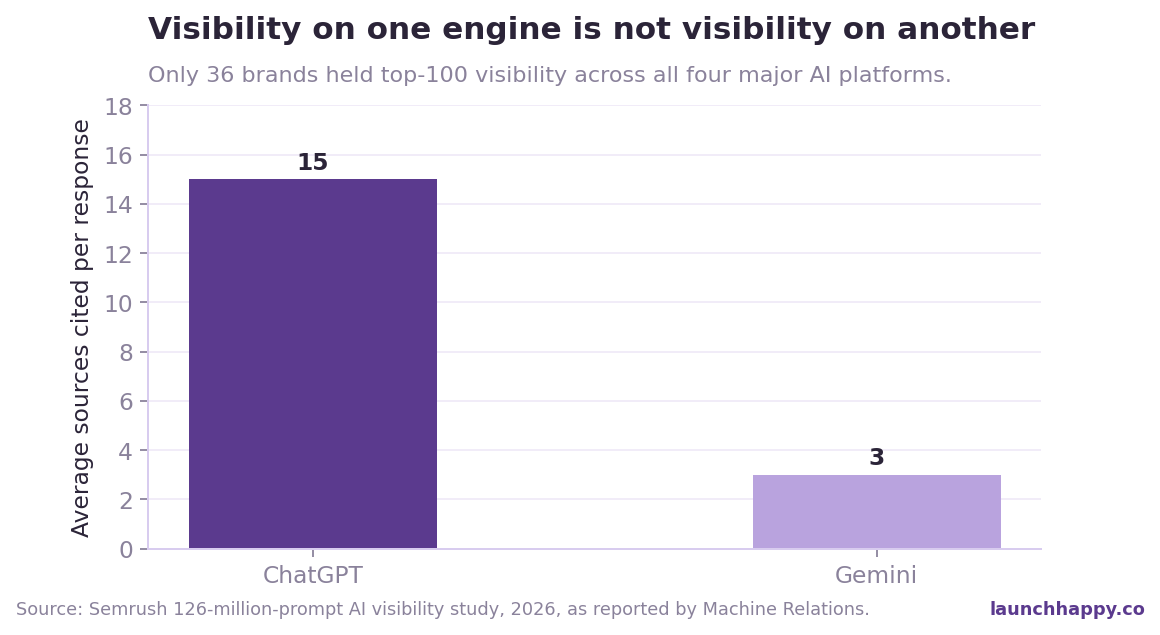
Figure 9: Visibility on one engine is not visibility on another
Is any of this worth the effort given falling click-through rates? The traffic is smaller and better. Seer Interactive's study of 3,119 informational queries across 42 organizations found organic CTR fell 61%, from 1.76% to 0.61%, where an AI Overview appears — but brands cited in those AI Overviews earned roughly 35% higher organic CTR and 91% higher paid CTR than uncited brands on the same queries [13]. Semrush valued AI-referred visitors at around 4.4x traditional organic visitors [16].

Figure 10: Being cited pays, on the same queries
Written by the LaunchHappy GEO team. LaunchHappy measures AI visibility against a frozen question set and reports what changed. See the GEO Report.
References
[1] Google Search Central, FAQ (FAQPage, Question, Answer) structured data, updated 8 May 2026 — https://developers.google.com/search/docs/appearance/structured-data/faqpage [2] Google Search Central, AI features and your website, updated 10 December 2025 — https://developers.google.com/search/docs/appearance/ai-features [4] Google Search Central, General structured data guidelines, updated 10 July 2026 — https://developers.google.com/search/docs/appearance/structured-data/sd-policies [5] Google Search Central Blog, Changes to HowTo and FAQ rich results, 8 August 2023 — https://developers.google.com/search/blog/2023/08/howto-faq-changes [6] Aggarwal, Murahari, Rajpurohit, Kalyan, Narasimhan & Deshpande, GEO: Generative Engine Optimization, KDD '24, 24 August 2024 — https://dl.acm.org/doi/10.1145/3637528.3671900 [7] Puerto et al., C-SEO Bench, 2025 — https://arxiv.org/pdf/2606.20065 [9] Ahrefs (March 2026), AI Overview citation overlap with top-10 organic results, as reported by Digital Applied — https://www.digitalapplied.com/blog/ai-search-citation-ranking-factors-2026-data-study [10] Cyrus Shepard / Zyppy, AI Citation Ranking Factors, 7 May 2026, as reported by PPC Land — https://ppc.land/23-factors-that-actually-get-your-content-cited-by-ai-search-engines/ [11] Zyppy / Authoritas (2025), positional bias in LLM citations, as reported by AI Thinker Lab — https://aithinkerlab.com/generative-engine-optimization-2026/ [13] Seer Interactive (September/November 2025), AI Overviews CTR study, as reported by Omnibound — https://www.omnibound.ai/blog/ai-seo-statistics [14] BrightEdge (February 2026), AI Overview trigger rate and citation source data, as reported by Omnibound — https://www.omnibound.ai/blog/ai-seo-statistics [15] Semrush 126-million-prompt AI visibility study (2026), as reported by Machine Relations — https://machinerelations.ai/research/ai-search-citation-factors-2026 [16] Semrush (June 2025), AI-referred visitor conversion rate, as reported by Omnibound — https://www.omnibound.ai/blog/ai-seo-statistics [17] Growth Memo (March 2026), ChatGPT citation concentration by domain, as reported by Position Digital — https://www.position.digital/blog/ai-seo-statistics/ [18] ConvertMate, AI Visibility Study (80 million citations, 10,000+ domains), as reported by SLT Creative — https://www.sltcreative.com/ai-seo-statistics [19] Conductor (2026), share of marketers tracking AI search performance, as reported by AI Thinker Lab — https://aithinkerlab.com/generative-engine-optimization-2026/ [20] Jeremy Howard / Answer.AI, llms.txt proposal, 3 September 2024 — https://llmstxt.org [21] Search Engine Land, Meet llms.txt, a proposed standard for AI website content crawling, July 2025 — https://searchengineland.com/llms-txt-proposed-standard-453676 [22] PPC Land, llms.txt adoption stalls as major AI platforms ignore proposed standard, 2 July 2025 — https://ppc.land/llms-txt-adoption-stalls-as-major-ai-platforms-ignore-proposed-standard/ [23] Digital Strategy Force, llms.txt adoption analysis, April 2026 — https://digitalstrategyforce.com/journal/does-your-site-need-llms-txt-to-get-cited-by-ai-search-in-2026/ [25] SearchPilot controlled test of FAQPage markup removal, as reported in 2026 coverage of the deprecation — https://orangemonke.com/blogs/google-drops-faq-rich-results-from-search/ [26] Google Search Central, Q&A (QAPage) structured data — https://developers.google.com/search/docs/appearance/structured-data/qapage [27] Google Search Central, Understand the JavaScript SEO basics — https://developers.google.com/search/docs/crawling-indexing/javascript/javascript-seo-basics [29] Schema.org, FAQPage — https://schema.org/FAQPage [30] Google Search Central, Organization structured data — https://developers.google.com/search/docs/appearance/structured-data/organization [31] LaunchHappy GEO Certified program research, citation-models.md — first-party measured research, 2026 [32] LaunchHappy Panel B measured baseline, 26 July 2026 (300 measured answers, 2,026 cited references) — first-party